Sintered neodymium magnet coating is essential. The coating is not a finish that makes the part look better. It is the only thing standing between the magnet and the atmosphere.
Get it wrong and the magnet fails in service rather than at the design stage. This article covers why neodymium needs plating, what each coating does, how to choose one for your environment, and the two things a coating will not do for you.
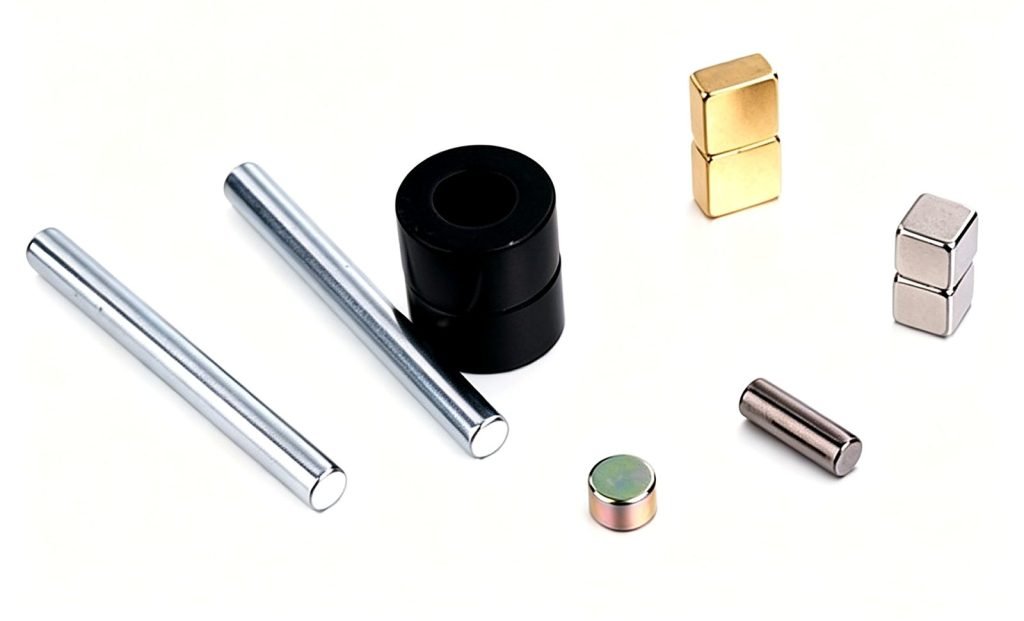
Why Neodymium Magnets Need a Coating
A sintered NdFeB magnet is roughly two thirds iron by weight. It is held together by sintering rather than by a continuous metal matrix. That structure leaves the grain boundaries exposed, and in humid air the iron at those boundaries oxidises quickly.
A bare sintered magnet left in a normal room shows rust spots within days. In a warm or salty environment the surface starts to flake. The corrosion follows the grain boundaries, so the part does not simply discolour. It loses material and eventually crumbles.
Plating seals the surface. Every coating below is judged on the same thing: how well it keeps moisture away from the sintered body, and for how long.
Coating Options Compared
| Coating | Plating layer | Coating thickness (μm) | Adhesive Endurance | Color | Salt Spray Test (h) | Electric Resistance |
|---|---|---|---|---|---|---|
| Zinc Coating | Zinc | 5-10 | Good | White blue | 24–48 | Good |
| Color Zinc | Colorful | |||||
| Nickel Coating | Nickel-Cu-Nickel | 10-25 | Excellent | Silver | 36–72 | Excellent |
| Epoxy Coating | Nickel-Cu-Epoxy | 15-30 | Excellent | Black/Grey | 96–168 | Excellent |
| Ag Coating | Nickel-Cu-Gold | 10-25 | Excellent | Gold | 72 | Good |
| Passivation | Parylene | 5-20 | Good | Grey | 200+ | Good |
| Dacromet Coating | Ni-Cu-Dacromet | 15-25 | Excellent | Grey | 800 | Good |
Corrosion performance also depends on shape and dimensions — sharp edges and small holes reduce coating uniformity. Salt-spray data per ASTM B117.
Choosing a Coating for Your Environment
Indoor, dry, handled rarely. Nickel-copper-nickel is the default and the cheapest. It is hard, it takes a bright finish, and it is what most catalogue magnets are plated with. If nothing in the application mentions moisture, heat or chemicals, start here.
Humid, coastal or outdoor. Move to zinc or epoxy. Epoxy is the stronger choice where the part also sees salt spray or repeated condensation. It is also electrically insulating, which matters when the magnet sits against a PCB or near a sensor coil.
Automotive or under-hood. Epoxy and Dacromet both hold up against salt spray and road chemicals. Dacromet is usually specified where the part also has to resist high temperature, because it is applied and cured differently from a plated coating.
Parts that people touch. Nickel is a common contact allergen. If the magnet is handled by end users, or sits in a product worn against the skin, epoxy or Parylene avoids putting nickel in contact with skin. Both also survive repeated wiping with cleaning solvents.
Sensors and audio. Gold over nickel-copper is chosen less for corrosion than for stable contact resistance, where the magnet doubles as an electrical component.
Every coating above is available on custom sintered neodymium magnets. See our customized magnets range, and the block and arc segment magnets we plate to order.
Coating Thickness Is Part of Your Tolerance
Plating adds material to every surface, and the numbers are not small next to magnet tolerances. At 10 to 25 μm per surface, the coating is the same order as the tolerance itself.
That leaves two ways to write the drawing. Either the dimensions are the finished, plated dimensions and the magnet is ground undersize first, or the dimensions are pre-plate and the coating is allowed to sit on top. Both are workable. The drawing has to say which one it is, because the difference shows up in assembly.
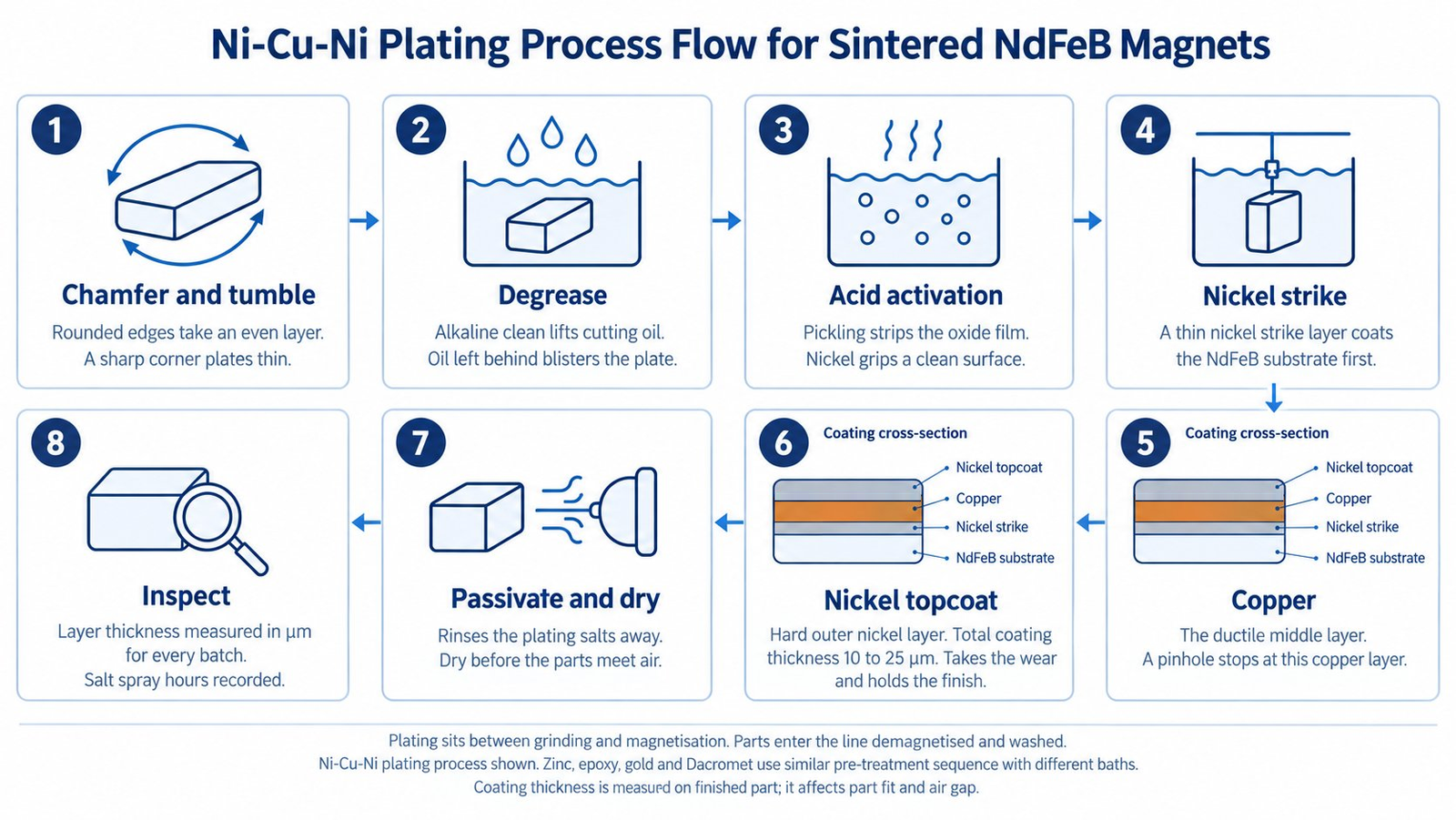
Plating also builds up unevenly. It goes on thicker at edges and corners, and thinner on sharp features. It covers the inside of a drilled hole less well than the outer surface. This is why magnet edges are chamfered and hole rims are deburred before plating. A rounded edge takes an even layer. A sharp one ends up with a thin spot, and sharp corners are where plating failure starts.
Why Coating Comes After Machining and Before Magnetizing
The order is fixed: cut and grind, clean, plate, magnetize, inspect.
Machining after plating would strip the coating from the freshly cut face. Drilling after plating would leave the inside of the hole bare. Magnetizing is left until last. A magnetized part attracts every particle of grinding and plating debris in the shop. A plating bath is no place for a magnet that is trying to hold on to loose material.
What a Neodymium Magnet Coating Will Not Do
A coating does not add holding force. It is non-magnetic, and it sits between the magnet and the target. A thicker coating is slightly worse magnetically, not better. Where a magnet has to work across a gap, the coating is part of that gap.
A coating does not raise the working temperature either. That is set by the grade, and no plating changes it.
The last limit is mechanical. These are thin layers on a brittle body. A magnet dropped onto a hard floor will chip the plating at the edge. A chip is not simply cosmetic: it exposes bare sintered material, and corrosion starts exactly there. If parts are handled roughly during assembly, a chamfer and a tougher coating such as epoxy will outlast a thicker nickel layer.
If you are not sure which coating suits your application, tell us where the magnet sits and what it will be exposed to. Humidity, salt, cleaning chemicals, temperature, and whether it is touched. Our engineers will confirm the coating and thickness against your drawing.
Frequently Asked Questions
Can a chipped coating be repaired?
Not in place. The part has to be stripped and re-plated, and stripping can take a little magnet material with it at the damaged spot. A chip that reaches the sintered body will corrode underneath the coating, so it is worth catching before assembly.
What do the salt spray hours actually tell me?
They rank coatings against each other under one standard test. They are not a service life. ASTM B117 runs a constant salt fog, without the drying cycles, the vibration or the temperature swings a real part meets. Use the hours to choose between two coatings, not to promise a number of years.
Can you coat only part of the magnet?
We can mask a face, but the plating still builds unevenly along the boundary of the mask. A partly coated part usually corrodes at the edge of the coating, which is worse than coating the whole part or none of it. If a face has to stay bare, tell us which one and why, and we will advise on the edge treatment.
Send the Drawing, We Will Confirm the Coating
Tell us where the magnet sits and what it will be exposed to. We will come back with the plating layer, the thickness, and a note on what that thickness does to your fit and your air gap.
Send Your Drawing