Adhesive magnets are neodymium discs with a pressure-sensitive adhesive on the rear face. Peel the liner and press the magnet onto a surface. It is the fastest way to add a magnetic hold to a housing that is not made of steel.
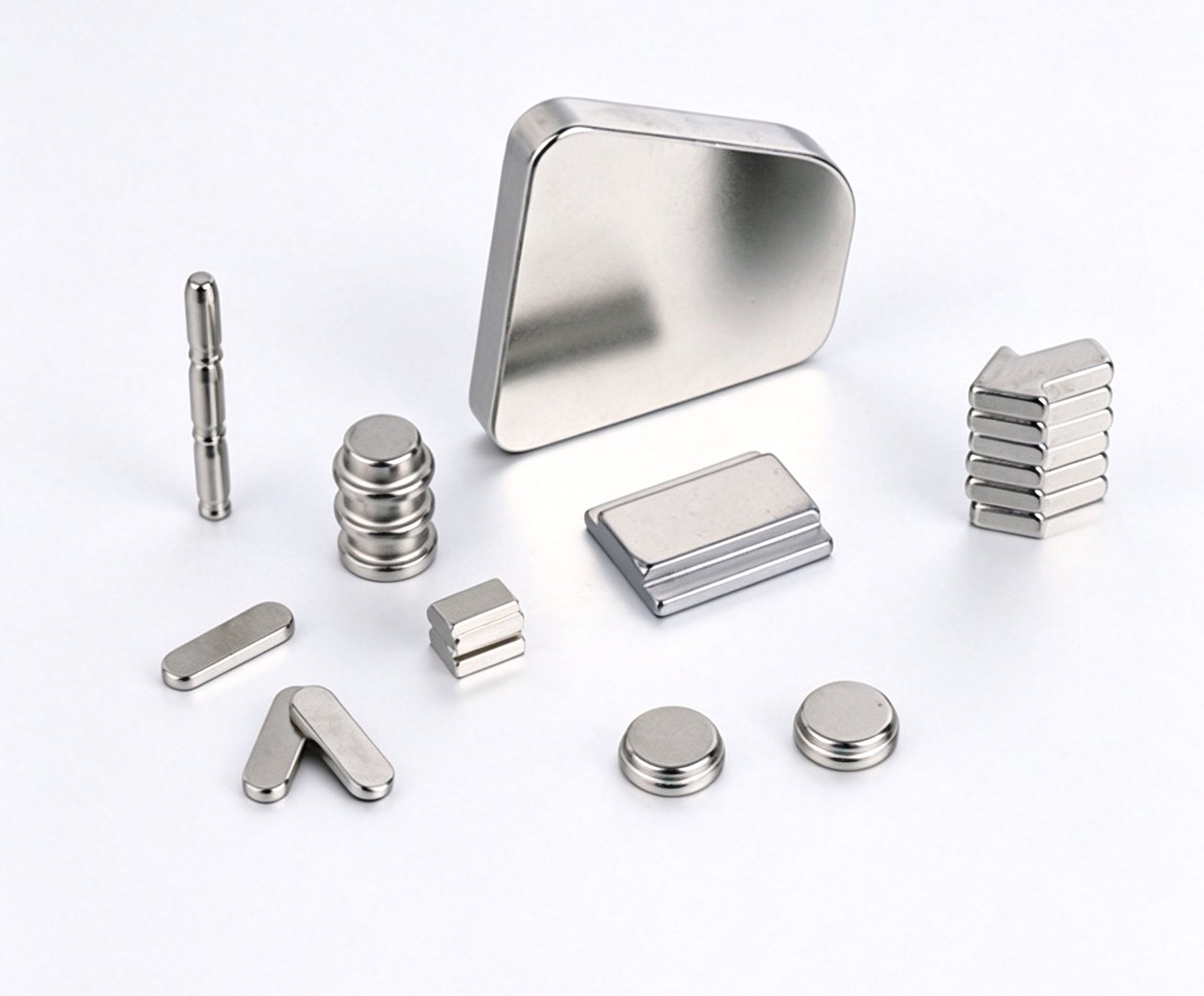
The range covers two families: standard discs, ready to stick, and customized magnets machined to your drawing.
What Adhesive Magnets Are Used For
Adhesive discs are used wherever there is no steel to hold a magnet directly.
- Signs, nameplates and trim on plastic enclosures, glass doors and painted panels
- Sensors and brackets
- Closures for dispensers and packaging
- Retail displays and exhibition branding
- Whiteboard accessories
None of those need a hole. That is the point.
Adhesive magnets exist because of a mismatch between materials. Most housings are plastic, aluminium or glass, and none of those carry a magnetic circuit. A tape-backed magnet turns the housing into a mounting surface. The adhesive holds the magnet to the plastic, and the free face provides the pull towards the steel part it has to catch. The result is a magnetic closure on a part that never had a hole in it. It is fitted by hand in seconds, with no fastener to source and no tolerance stack to manage.
How Adhesive Magnets Work
An adhesive magnet does two jobs in one part. The adhesive holds it to the host surface. The opposite face provides the magnetic pull towards the steel part it must catch. The two faces are opposite each other on a disc, so the first question on any drawing is which face does the work.
The adhesive is normally an acrylic pressure-sensitive tape. Acrylic tapes bond firmly to clean surfaces and resist creep under a steady load better than rubber-based tapes. Magnets are available in N30 to N38AH.
The maximum service temperature of the finished part is usually around 80 °C. That limit comes from the adhesive, not the magnet. The tape softens long before the magnet loses its magnetism. If the part sits near a heat source, the tape is the first thing to check and the first thing to fail.
The magnet also has to be big enough to be worth taping. Adhesive discs use disc magnets for the pull force, and the same rule applies here as anywhere else. Force falls steeply once there is a gap, and the tape plus the panel it sticks to is already part of that gap.
Choosing the Tape for Your Surface
The tape is chosen from the surface, not from the magnet. The table below is a starting point. If the surface is unusual, send us a sample of the material. We will confirm the adhesive rather than guess.
| Surface or condition | Tape | Why |
|---|---|---|
| Clean, smooth, dry — painted steel, glass, ABS, PC | Acrylic transfer tape | The standard case; thin, strong and stable in humidity |
| Low-surface-energy plastic — PP, PE, PTFE | Low-surface-energy acrylic, or a primer | Ordinary acrylic will not wet out; these plastics need a primer or an LSE-rated adhesive |
| Curved or slightly uneven surface | Foam-backed acrylic tape | The foam takes up the curvature, so the bond still has full contact area |
| Outdoor or high humidity | Acrylic foam tape, edge sealed | Acrylic resists moisture and UV better than rubber-based tapes |
| Above about 80 °C | No tape — use mechanical fixing | The adhesive softens first; the magnet is not the limiting part |
| Oily, dusty or rough surface | No tape — use mechanical fixing | The adhesive cannot reach its rated strength on a contaminated surface |
Two practical notes. Adhesive strength builds over time and reaches its full value after roughly 24 hours at room temperature. A part tested immediately after assembly will appear weaker than it really is. And the tape needs pressure to make contact. A magnet pressed on by hand and one pressed on with a roller are not the same joint. Where a bond carries a real load, specify it as a bonded joint rather than as a convenience.
How Adhesive Magnets Are Made
Standard adhesive magnets start as ground neodymium discs plated with Ni-Cu-Ni. The magnet is cleaned, laminated with the adhesive tape and release liner, and die-cut to the finished disc size.
The adhesive is applied after plating and after magnetization. The process therefore ends with a bond-strength check on a sample from the lot. The tape and the magnet arrive as one unit, rather than as two parts the customer has to join.
Coating still matters even though the tape hides one face. The exposed magnetic face is the one that works, and it corrodes like any other. Our guide to neodymium magnet coating covers the finishes and the environments they suit.
Customized Magnets and Custom Shapes to Your Drawing
About half of what we ship in this range is not a standard disc. It is a magnet machined to a customer drawing. The same sintering and machining route that makes a disc or a block will produce almost any geometry a housing or a sensor needs. The tape can then be applied to any flat face of the finished part.
- Step and profile magnets. A shoulder registers the part in a moulded pocket so it cannot sit crooked.
- Shaped magnets. Triangular, trapezoidal and run-way profiles for sensors and encoders.
- Ring and arc variants. Wall thickness or arc angle outside the standard range.
- Assemblies. A magnet bonded into a steel housing, or supplied over-moulded, as one finished part.
- Marked parts. Polarity, part number or a code marked on the non-working face.
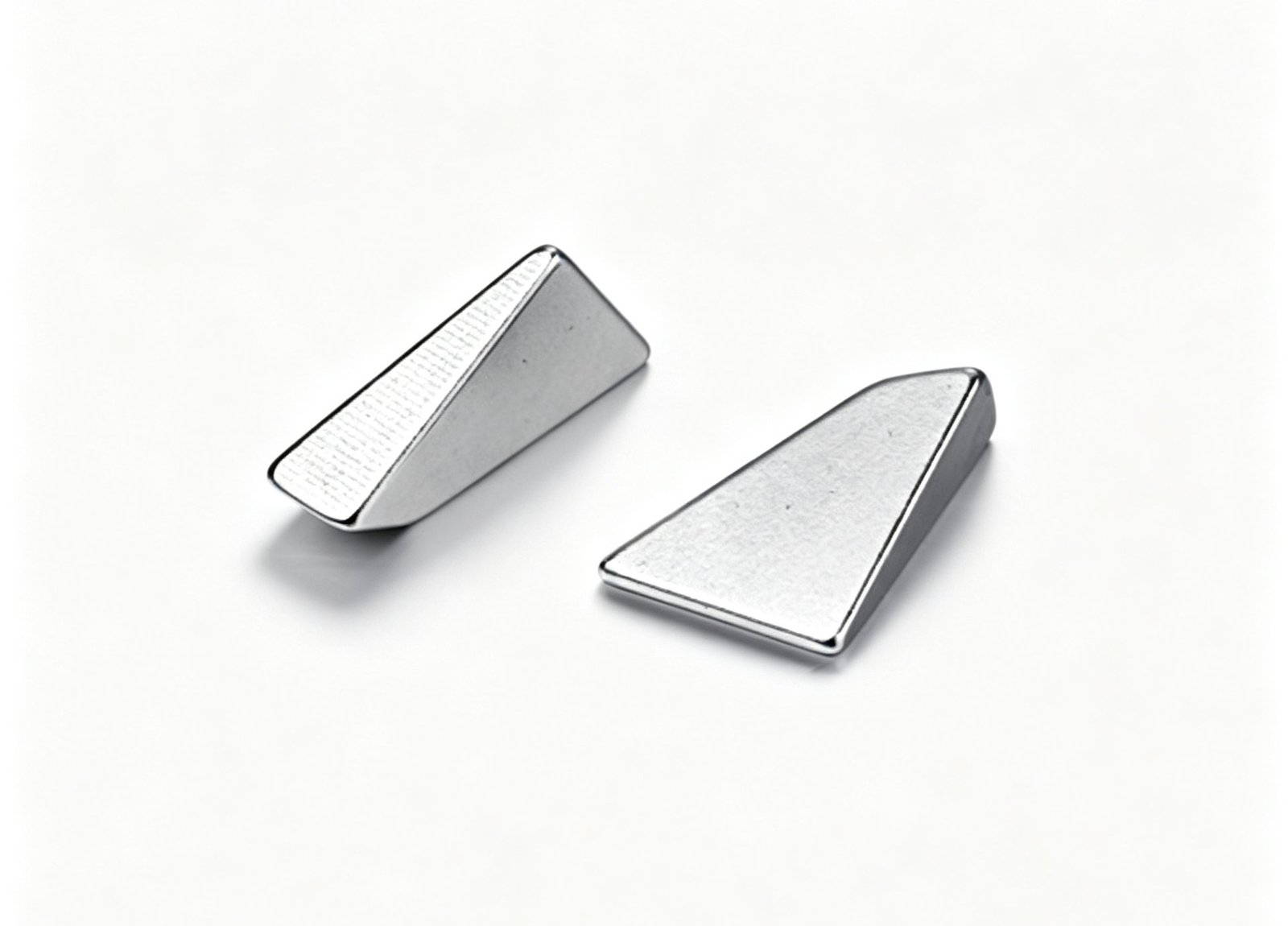
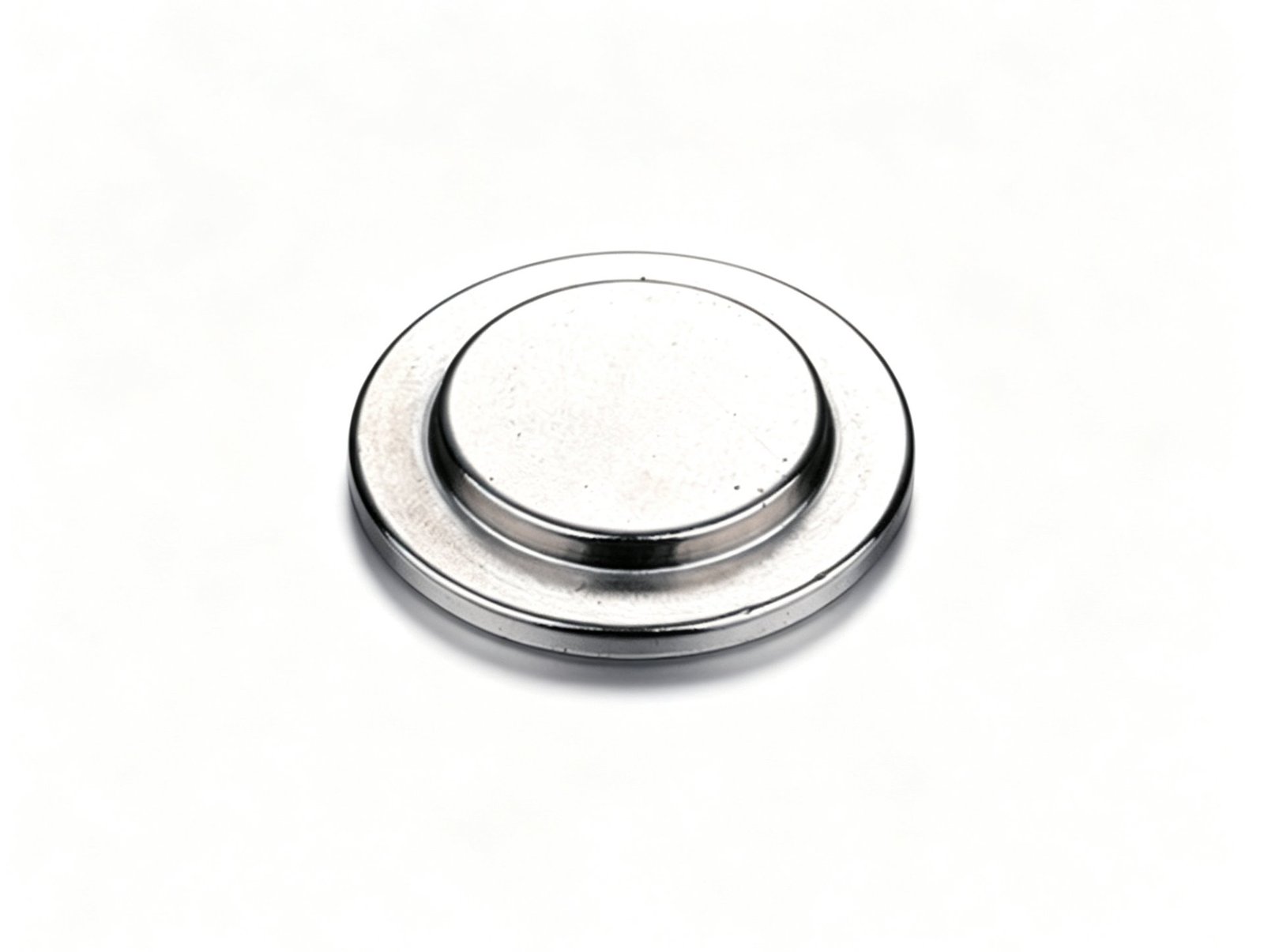
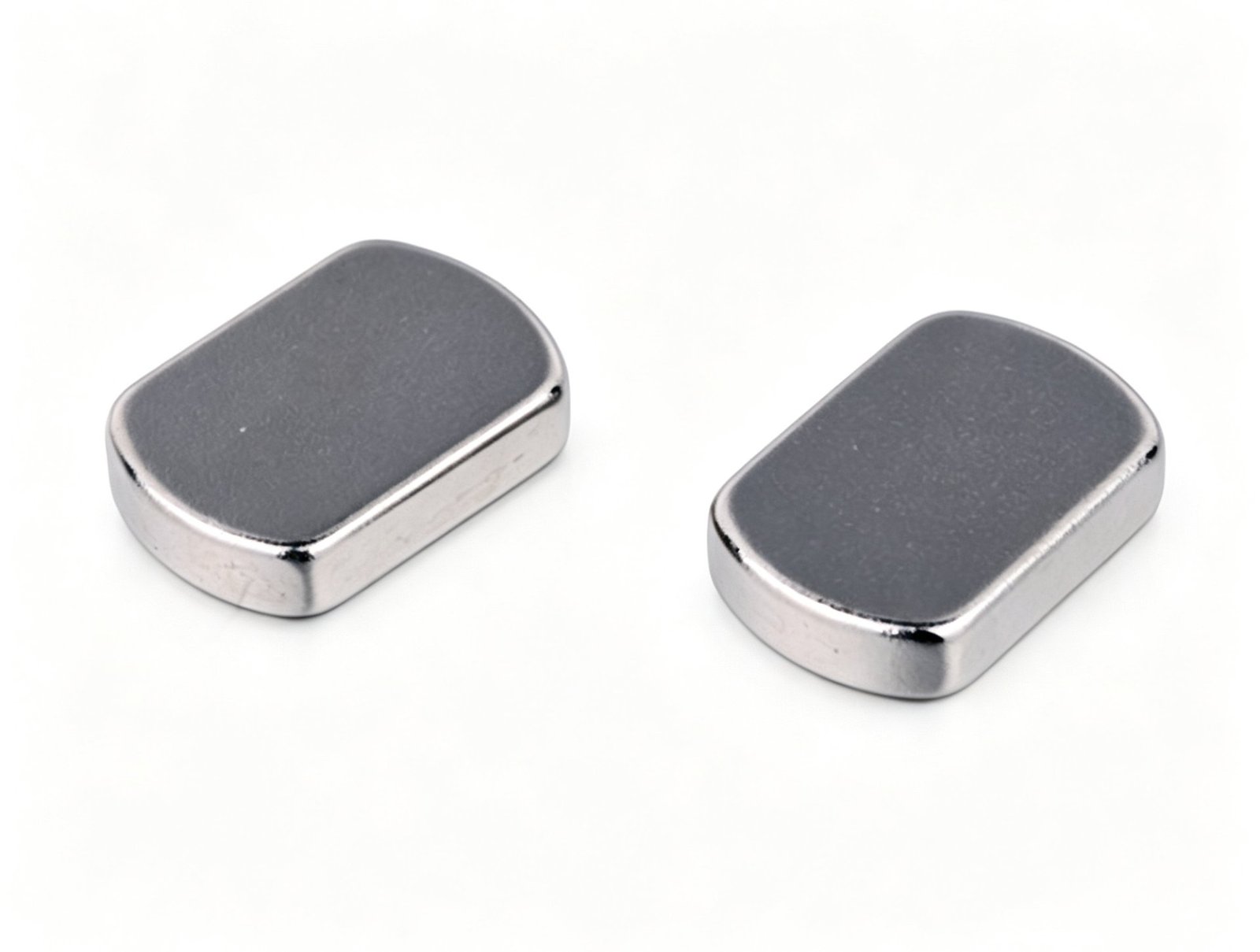
To quote a custom part we need a drawing with the geometry, the grade, the magnetization direction, the coating, and the tolerance on the features that matter. If all you have is a 3D file or a sketch, send that. The first two things our engineers check are which face carries the pole and how the part will be held during grinding. Those two decisions drive both the price and whether the tolerance you asked for is achievable.
Tolerance, Flatness and the Laminated Stack
Standard discs follow normal grinding tolerances, typically ±0.1 mm on diameter and thickness. The adhesive layer is controlled so the overall thickness stays inside the range. For custom parts the drawing drives inspection: ±0.05 mm on critical features such as holes and seating faces, and ±0.1 mm on less critical lengths.
Flatness of the adhesive face matters more here than on any other magnet shape. A curved or dished face reduces contact area, and reduced contact area is reduced bond strength. Flatness is therefore measured on every batch rather than left to the grinding tolerance.
Laminating the tape also moves the neutral axis of the stack. On a thin magnet the tape contributes meaningfully to stiffness, and on a very thin disc the tape layer can dominate the finished thickness. Where overall height has to be exact, state the dimension as a plated-and-laminated finished size.
Edges are chamfered 0.2 to 0.5 mm, so the hard, brittle material does not chip when the part is pressed onto a surface or stacked with others. On the taped face the chamfer is kept small, so the adhesive keeps its full bonding area. A small radius on the magnetic face stops it scratching the steel it catches. On custom shapes every internal corner and hole is deburred and given a small radius, which improves plating coverage and removes the stress risers where cracks start.
Frequently Asked Questions
What counts as a customized magnet here?
Anything machined to your drawing. Standard discs ship from stock, while customized magnets are cut, drilled or laminated to the shape your part needs. Most customized magnets start from a sample or a 2D drawing.
Can I reposition an adhesive magnet after pressing it on?
Only if you do it immediately. Once the acrylic has wet out and started to build strength, the tape will not reach its rated strength again. Pulling the magnet off leaves adhesive on the surface and on the magnet. For parts that will be placed by hand and sometimes placed wrong, say so and we will quote a removable grade or suggest a mechanical fixing instead.
How much weight will an adhesive magnet hold?
Two limits apply, and the lower one governs. The first is the magnetic pull towards the steel part. The second is the shear strength of the adhesive joint, which is set by the tape and the surface area. Adhesive joints resist shear far better than a direct pull. A magnet supporting a hanging weight is a much harder case than one holding a part that slides. Tell us the load, its direction and the surface, and we will size both the magnet and the tape against it.
Can the tape be applied to the magnetized face?
No. Only one face can carry the tape, because the other face is the working face that has to touch the steel. Tape on the polar face is rare. Where a part does need it, the magnet is usually specified with a shaped or stepped profile. The taped area and the working face are then not the same surface.
Is there a coating under the tape?
Yes. The disc is plated before laminating. The plating has to be continuous over the whole part for corrosion protection, and a part with tape already on it cannot be plated. This also means the tape bonds to a hard, clean, consistent surface rather than to bare sintered material.
Send us the size and pull force you need, or a fully custom magnet to your drawing. Our engineers will confirm the grade, coating and tolerance before production. You can also browse the full neodymium magnet range by shape.