Sometimes you can. But the datasheet values do not transfer one to one, and the gap widens as the temperature rises. If you are still weighing materials, see neodymium vs ferrite magnets first.
Why does the swap come up at all? A 2:17 samarium magnet is roughly half cobalt by weight. A sintered neodymium magnet is about 60 percent iron. Cobalt costs far more than iron, so samarium cobalt normally sells at two to four times the price of neodymium. Fewer factories make it, capacity is smaller, and lead times are longer. In most projects those three points start the conversation about how to replace a samarium magnet with a neodymium one. Performance is rarely the trigger.
A material datasheet lists four numbers: Br, (BH)max, Hcb and Hcj. Three of them do not describe the field at a fixed distance. Only Br sets that field. And Br falls about three times faster in neodymium as the magnet heats up.
This page covers what has to be recalculated before you replace a samarium magnet with a neodymium one, and the cases where samarium cobalt is still the right answer.
Four steps cover most of the work:
- Read Br for both grades at the highest temperature the part really sees, not at 20 °C.
- Put the working point on the demagnetization curve, and measure the margin to the knee at that temperature.
- Check that the stronger room-temperature field stays inside the limit of the sensor or the assembly.
- Check what the coating adds. It changes the fit and the effective air gap.
The Four Numbers Do Not Transfer From Sm2Co17 to NdFeB
| Parameter | What it actually tells you |
|---|---|
| Br (remanence) | The flux density the material can hold. This is the number that sets the field at a fixed distance, for the same shape and the same magnetization. |
| (BH)max (energy product) | How much magnetic energy fits in a given volume. It guides material choice and sizing. It does not tell you the field at one point. |
| Hcb (coercivity) | Where the working point sits on the demagnetization curve. It describes the shape of the curve. |
| Hcj (intrinsic coercivity) | How hard the magnet is to demagnetize. This decides whether the magnet keeps its strength after a hot excursion. |
So the answer to “are they directly transferable” is no. They are not the same kind of quantity. (BH)max is not a field. Hcj is not a field. Only Br maps to the field you measure.
Two field plots make the point concrete. Both use the same block, the same mesh and the same probe point at the centre of the magnet. Only the material changed. Two magnets of the same size still sit at different points on the curve: different |B| and different |H|.
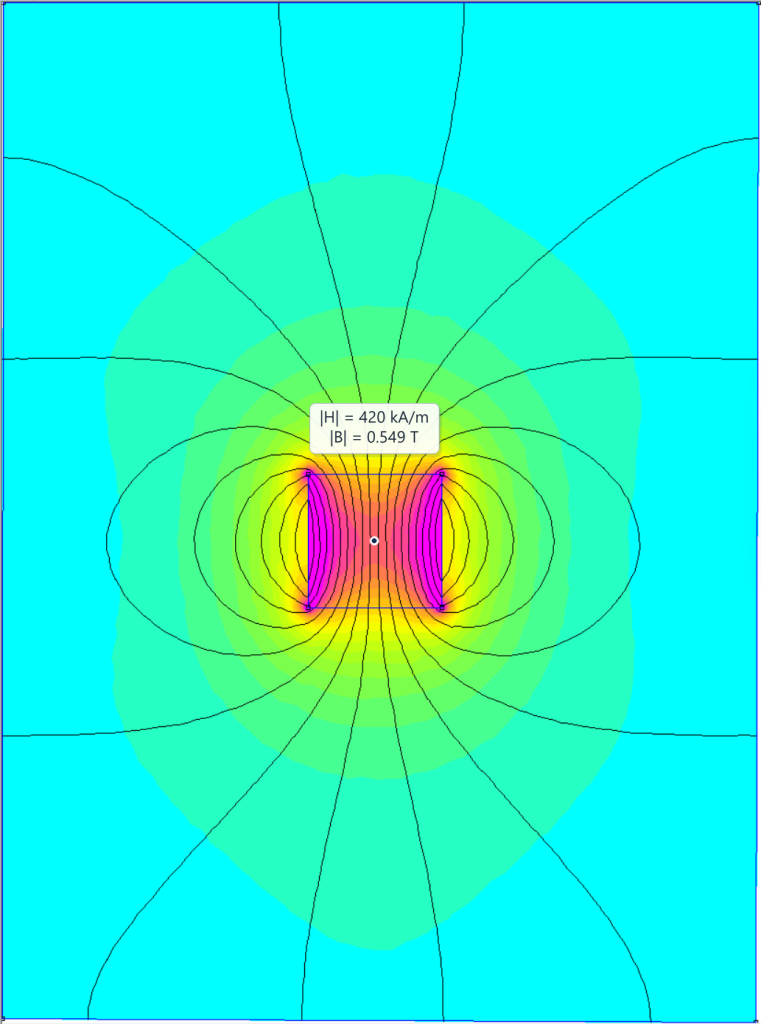 Sm2Co17, 20 °C
|H| = 420 kA/m · |B| = 0.549 T
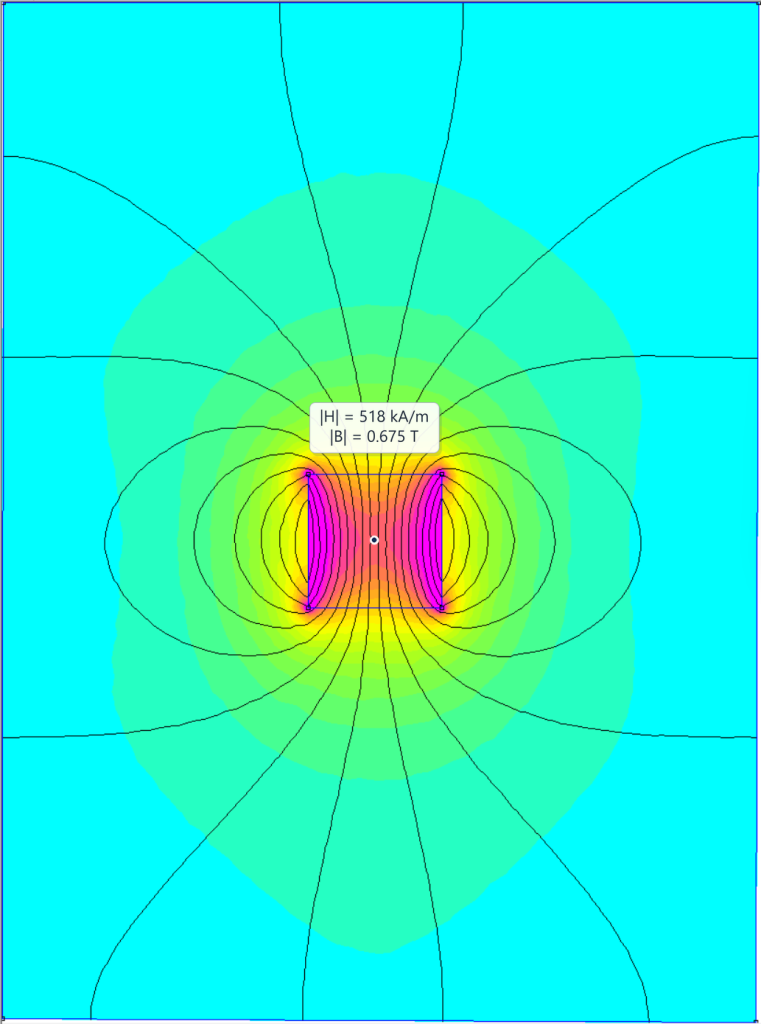 N45UH neodymium, 20 °C
|H| = 518 kA/m · |B| = 0.675 T
What |H| and |B| Mean in a Field Plot
Both numbers are read at the same point inside the magnet.
- |B| is the flux density at that point, in tesla. A Hall sensor in the gap reads this number, so it decides the signal level you get.
- |H| is the field strength at that point, in kA/m. Inside a magnet it points against the magnetization, which is why it is called the self-demagnetizing field.
- The pair (|H|, |B|) is the working point. Put it on the demagnetization curve and you can see where the magnet sits, and how far it is from the knee.
Read the two plots together. At 20 °C the neodymium block gives |B| = 0.675 T at the probe point. The samarium block gives 0.549 T, about 23 percent less. The working point moves as well: |H| = 518 kA/m for neodymium, 420 kA/m for samarium. The neodymium magnet works at a bigger opposing field, so it sits further along its own curve.
That is the whole calculation in one picture. You cannot scale datasheet numbers from one material to the other, because the working point moves too. At 20 °C the knee of the neodymium curve is far away, at about 1977 kA/m. At 180 °C it is at about 588 kA/m, and the margin becomes thin. If you plan to replace a Sm2Co17 magnet with a neodymium one, simulate the real grade at the real temperature and check the working point against the J-H curve.
Br Sets the Field, and It Falls Faster in Neodymium
Sintered neodymium carries a higher Br than samarium cobalt at room temperature. N grades run from about 1.0 T to 1.45 T. SmCo runs from about 0.85 T to 1.15 T.
So the same size part in neodymium gives you a stronger field, not an equal one. To match the old field you usually reduce the magnet size, or you accept a stronger signal.
Temperature is where the swap becomes a real calculation. The reversible temperature coefficient of Br is about −0.11 %/°C for neodymium. For SmCo 2:17 it is about −0.03 %/°C. That is a factor of roughly three.
The working value follows a simple rule:
Br(T) = Br(20 °C) × [1 + α × (T − 20)]
At 180 °C two comparable grades come out close:
- SmCo 2:17, Br 1.08 T, α = −0.03 %/°C → about 1.03 T
- NdFeB N42SH, Br 1.28 T, α = −0.11 %/°C → about 1.06 T
At room temperature those two grades differ by 0.20 T. At 180 °C they differ by about 0.03 T. The neodymium advantage is nearly gone.
This is why a comparison based on 20 °C datasheet values says very little. Compare at the temperature the magnet will actually see.
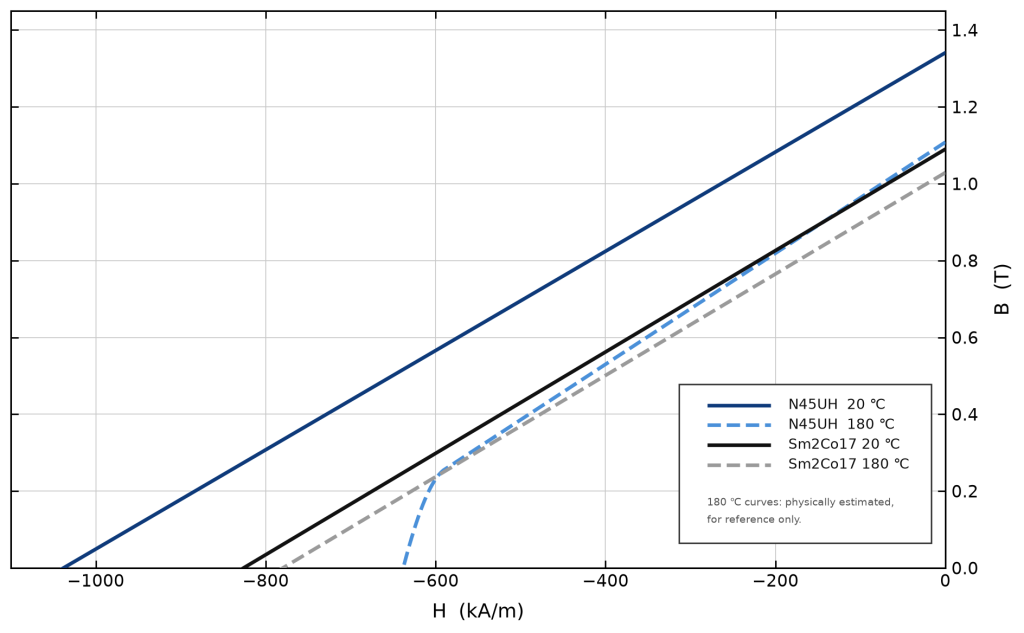
The chart below puts four curves side by side: an N45UH neodymium grade and a Sm2Co17 grade 30H, each at 20 °C and at 180 °C.
How to Read a B-H Demagnetization Curve
The bottom axis is the opposing field the magnet sees, in kA/m. Zero sits at the right and the values run negative to the left. This is the second quadrant, which is the region a magnet actually works in. The vertical axis is the flux density B in tesla, and it is drawn at H = 0.
- Where a curve meets the vertical axis, that is Br. At 20 °C the N45UH grade starts at 1.34 T and the Sm2Co17 grade at 1.09 T. That 0.25 T gap is the neodymium advantage at room temperature.
- Where a curve meets the bottom axis, that is Hcb. N45UH reaches zero at 1038 kA/m, the Sm2Co17 grade at 826 kA/m.
- The slope between those two points is the recoil permeability. A steeper line means B falls away faster as the opposing field grows.
- Read the 20 °C and the 180 °C line of one grade together. N45UH drops from 1.34 T to 1.11 T, about 17 percent. The Sm2Co17 grade drops from 1.09 T to 1.03 T, about 6 percent. That is the “three times faster” in one picture.
- Look at where a curve bends. The 180 °C neodymium curve bends over before it reaches zero, at about 588 kA/m. A bend means the magnet can lose flux for good. The Sm2Co17 curves stay straight all the way to the axis.
The 20 °C curves are measured on our own test bench. The 180 °C curves are modelled from the published temperature coefficients, because suppliers rarely publish hot curves.
Hcj Decides Whether the Field Comes Back
Loss of Br with heat is reversible. Cool the magnet down and the field returns. That is what the coefficient describes.
A second effect is not reversible. If the working point drops below the knee of the demagnetization curve, the magnet loses flux for good. The knee moves up as temperature rises, and it moves up faster in neodymium. This is what Hcj measures.
A grade with high Hcj pushes the knee to a higher temperature. That is why M, H, SH and UH grades exist. Each step adds dysprosium or terbium, and each step costs more.
Two checks before you commit:
- Take the highest temperature the magnet will ever reach, not the average.
- Keep the load line above the knee at that temperature, plus a margin.
If the highest temperature stays under about 80 °C, a standard N grade is usually fine. Between 80 °C and 150 °C, look at M, H or SH. Above 150 °C, run the numbers before you drop samarium cobalt.
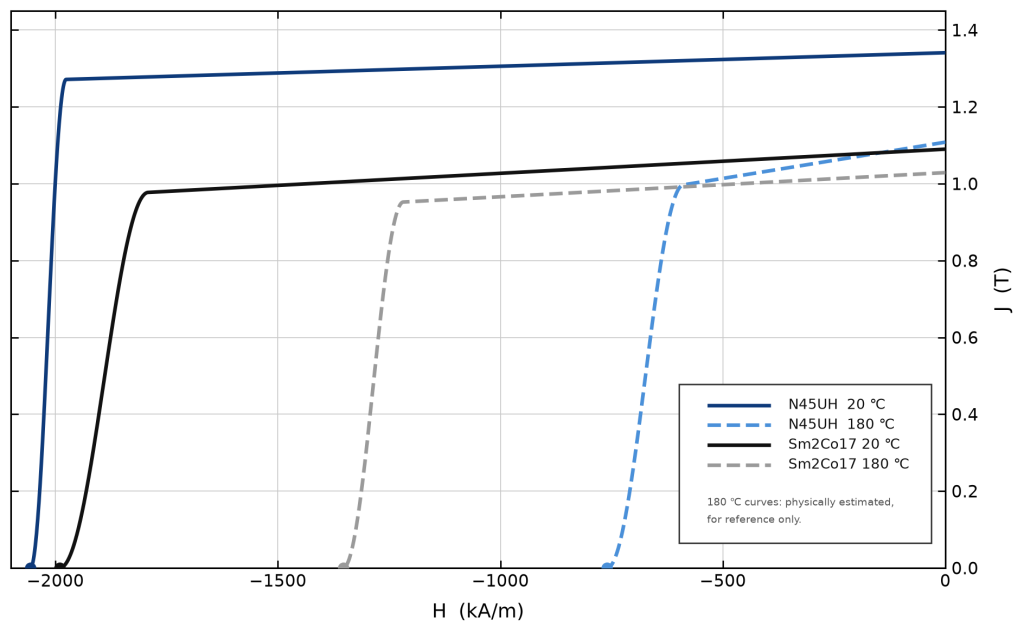
The same four curves, plotted as intrinsic curves.
How to Read a J-H Intrinsic Curve
J is the polarization of the magnet material itself, in tesla. It is defined as J = B − µ0H. Because H is negative in this quadrant, J is always larger than B at the same point. The axes follow the same layout: H negative to the left, J on the vertical axis.
- The curve is flat, and then it is not. While J is flat the magnet is stable: take the opposing field away and the flux returns. The point where J starts to drop is the knee.
- Where J reaches zero, that is Hcj. At 20 °C the two grades look close: 2056 kA/m for N45UH and 1990 kA/m for the Sm2Co17 grade.
- The knee is the number to watch, not Hcj. A magnet pushed past its knee loses flux for good, even though the Hcj value still looks comfortable.
- Now look at 180 °C. The neodymium curve collapses: Hcj falls from 2056 kA/m to 760 kA/m, and the knee lands at about 588 kA/m. The Sm2Co17 grade holds up much better, with the knee at about 1218 kA/m and Hcj still at 1353 kA/m.
- Use the two charts together. The B-H chart tells you where the magnet works today. The J-H chart tells you how much room is left before the loss becomes permanent.
Both charts and the grade table are collected on one printable sheet, with the working point of each material in the same block. Download the Sm2Co17 vs NdFeB data sheet (PDF, 2 pages).
Angle Sensors: Replace a Sm2Co17 Magnet With a Neodymium One
A diametrically magnetized part that sets a travel angle is a different case.
An angle sensor reads the direction of the field, not its size. Field direction is far more stable against temperature than field strength. So the temperature coefficient matters less here than it would in a holding or pulling application.
Three things still need checking:
- Sensor input range. Neodymium gives a stronger field at the same gap. Check that the sensor is not driven into saturation.
- Signal amplitude. Some angle algorithms use the amplitude of both channels. A changing amplitude changes the compensation, not only the signal level.
- Air gap. You may need to move the sensor further away to bring the field back into range. That also reduces the effect of mechanical runout.
Three More Things Change With the Material
Density. SmCo is about 8.4 g/cm³ and sintered NdFeB about 7.5 g/cm³. The same size part is roughly 12 percent lighter in neodymium. If the part rotates, check the balance.
Coating. Samarium cobalt resists corrosion on its own, so it is often used bare. Sintered neodymium will corrode without a coating, so it needs Ni-Cu-Ni, zinc or epoxy. A coating adds thickness. In a tight assembly that changes the effective air gap and the fit. The coating guide compares the options.
Whichever material wins, the geometry still has to fit. We grind arc segments and custom shapes to drawing in both neodymium and samarium cobalt.
Five Questions Before You Replace a Samarium Magnet With a Neodymium One
- What is the highest temperature the magnet reaches?
- What Br does the current magnet deliver at that temperature?
- Can a neodymium grade reach that Br there and stay above its knee?
- Does the stronger room-temperature field stay inside the sensor range?
- Does the coating change the fit or the air gap?
To replace a samarium magnet with a neodymium one, all five answers have to be yes. If question 3 fails, the answer is usually a higher grade, more dysprosium, and a higher price. At that point samarium cobalt may be the cheaper choice after all.
Frequently Asked Questions
Can I use both materials in the same assembly?
Yes, and it is often the sensible answer. A hot position can keep its samarium cobalt magnet while the cooler positions move to neodymium, which takes most of the cost out without touching the difficult case. Two materials in one assembly is normal.
How do I set a working limit when the supplier publishes no hot curve?
Work from the temperature coefficients. Derate Br with the published coefficient to get the field at temperature, put that point on the curve, and read the margin to the knee. Where the margin is thin, confirm it on a sample with a heating test, because the coefficient gives an average rather than your part.
Can the same part number be made in both materials?
The mechanical envelope, yes. The field, no. Neodymium gives more flux from the same size, so the sensor or the assembly has to be re-checked before the two versions can share a drawing number.
Send the Drawing, We Will Run the Numbers
Tell us the grade you use today, the highest temperature it sees and the size of the part. Our engineers will come back with a neodymium grade, the field it gives at the same point, and how close that working point sits to the knee.
Send Your Drawing