What Are Neodymium Magnets?
Neodymium magnets contain about 65% Fe, 30% Pr, and Nd, and are permanent magnets. They are the strongest commercial magnets available today. Most of them are made in China and exported to other countries.
At Acorn Magnet, we manufacture and supply sintered neodymium magnets in grades from N30 to N38AH, with no fixed minimum order. We can strictly produce according to your design and drawings, or, if possible, we are very glad to work with you to design, discuss, and think out the best solution.
Every magnet is produced under our 4-phase service assurance; we provide end-to-end technical support.
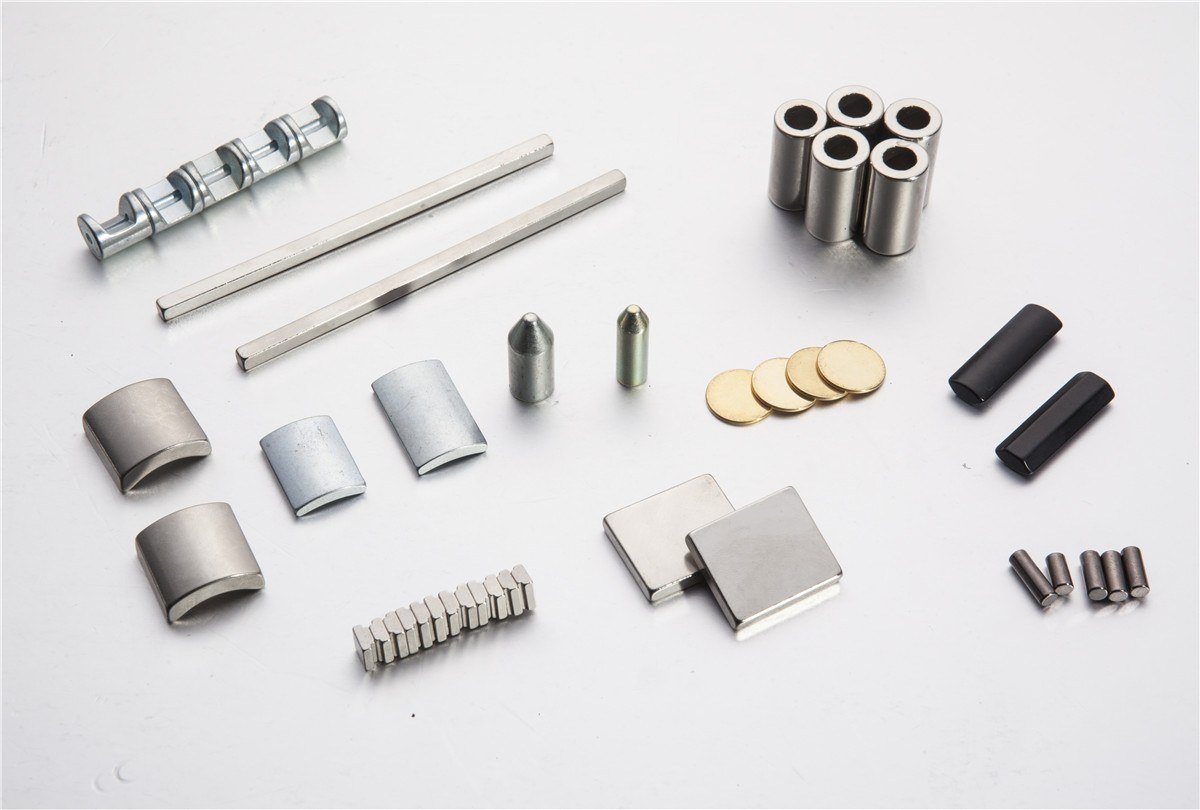
How Are Neodymium Magnets Made?
Neodymium magnets are produced by powder metallurgy. The NdFeB alloy is melted, jet-milled into a fine powder of around 3–5 μm, then pressed in a magnetic field that aligns the particles before sintering at about 1,080 °C in a vacuum or argon furnace. After sintering, the blocks are annealed, sliced or ground to tolerance, and finally coated — nickel-copper-nickel plating being the most common protection.
Because the material is hard and brittle, all machining is done with diamond tools or wire cutting; drilling and tapping are according to your design.
Key Magnetic Properties and Grades
Grade numbers indicate maximum energy product: a higher number means a stronger magnet. The letter suffix sets the maximum operating temperature and minimum intrinsic coercivity.
Neodymium Magnetic Properties Chart
| Grade | Remanence Br (T) |
Remanence Br (kGs) |
Coercivity Hcb (kA/m) |
Coercivity Hcb (kOe) |
Intrinsic Coercivity Hcj (kA/m) |
Intrinsic Coercivity Hcj (kOe) |
Max. Energy Product(BH)max (kJ/m³) |
Max. Energy Product(BH)max (MGOe) |
Max Working Temp (°C) |
|---|---|---|---|---|---|---|---|---|---|
| N30 | 1.08–1.13 | 10.8–11.3 | ≥798 | ≥10.0 | ≥955 | ≥12 | 223–247 | 28–31 | 80 |
| N33 | 1.13–1.17 | 11.3–11.7 | ≥836 | ≥10.5 | ≥955 | ≥12 | 247–271 | 31–34 | 80 |
| N35 | 1.17–1.22 | 11.7–12.2 | ≥868 | ≥10.9 | ≥955 | ≥12 | 263–287 | 33–36 | 80 |
| N38 | 1.22–1.25 | 12.2–12.5 | ≥899 | ≥11.3 | ≥955 | ≥12 | 287–310 | 36–39 | 80 |
| N40 | 1.25–1.28 | 12.5–12.8 | ≥907 | ≥11.4 | ≥955 | ≥12 | 302–326 | 38–41 | 80 |
| N42 | 1.28–1.32 | 12.8–13.2 | ≥915 | ≥11.5 | ≥955 | ≥12 | 318–342 | 40–43 | 80 |
| N45 | 1.32–1.38 | 13.2–13.8 | ≥923 | ≥11.6 | ≥955 | ≥12 | 342–366 | 43–46 | 80 |
| N48 | 1.38–1.42 | 13.8–14.2 | ≥923 | ≥11.6 | ≥955 | ≥12 | 366–390 | 46–49 | 80 |
| N50 | 1.40–1.45 | 14.0–14.5 | ≥796 | ≥10.0 | ≥876 | ≥11 | 382–406 | 48–51 | 80 |
| N52 | 1.43–1.48 | 14.3–14.8 | ≥796 | ≥10.0 | ≥876 | ≥11 | 398–422 | 50–53 | 80 |
| N55 | 1.46–1.52 | 14.6–15.2 | ≥796 | ≥10.0 | ≥876 | ≥11 | 414–430 | 52–54 | 80 |
| N35M | 1.17–1.22 | 11.7–12.2 | ≥868 | ≥10.9 | ≥1114 | ≥14 | 263–287 | 33–36 | 100 |
| N38M | 1.22–1.25 | 12.2–12.5 | ≥899 | ≥11.3 | ≥1114 | ≥14 | 287–310 | 36–39 | 100 |
| N40M | 1.25–1.28 | 12.5–12.8 | ≥923 | ≥11.6 | ≥1114 | ≥14 | 302–326 | 38–41 | 100 |
| N42M | 1.28–1.32 | 12.8–13.2 | ≥955 | ≥12.0 | ≥1114 | ≥14 | 318–342 | 40–43 | 100 |
| N45M | 1.32–1.38 | 13.2–13.8 | ≥995 | ≥12.5 | ≥1114 | ≥14 | 342–366 | 43–46 | 100 |
| N48M | 1.37–1.43 | 13.7–14.3 | ≥1027 | ≥12.9 | ≥1114 | ≥14 | 366–390 | 46–49 | 100 |
| N50M | 1.40–1.45 | 14.0–14.5 | ≥1033 | ≥13.0 | ≥1114 | ≥14 | 382–406 | 48–51 | 100 |
| N52M | 1.43–1.48 | 14.3–14.8 | ≥1050 | ≥13.2 | ≥1114 | ≥14 | 398–422 | 50–53 | 100 |
| N54M | 1.45–1.50 | 14.5–15.0 | ≥1051 | ≥13.2 | ≥1114 | ≥14 | 414–438 | 52–55 | 100 |
| N35H | 1.17–1.22 | 11.7–12.2 | ≥868 | ≥10.9 | ≥1353 | ≥17 | 263–287 | 33–36 | 120 |
| N38H | 1.22–1.25 | 12.2–12.5 | ≥899 | ≥11.3 | ≥1353 | ≥17 | 287–310 | 36–39 | 120 |
| N40H | 1.25–1.28 | 12.5–12.8 | ≥923 | ≥11.6 | ≥1353 | ≥17 | 302–326 | 38–41 | 120 |
| N42H | 1.28–1.32 | 12.8–13.2 | ≥955 | ≥12.0 | ≥1353 | ≥17 | 318–342 | 40–43 | 120 |
| N45H | 1.32–1.36 | 13.2–13.6 | ≥963 | ≥12.1 | ≥1353 | ≥17 | 342–366 | 43–46 | 120 |
| N48H | 1.37–1.43 | 13.7–14.3 | ≥995 | ≥12.5 | ≥1353 | ≥17 | 366–390 | 46–49 | 120 |
| N50H | 1.40–1.45 | 14.0–14.5 | ≥1011 | ≥12.7 | ≥1353 | ≥17 | 382–406 | 48–51 | 120 |
| N52H | 1.43–1.48 | 14.3–14.8 | ≥1027 | ≥12.9 | ≥1353 | ≥17 | 398–422 | 50–53 | 120 |
| N35SH | 1.17–1.22 | 11.7–12.2 | ≥876 | ≥11.0 | ≥1592 | ≥20 | 263–287 | 33–36 | 150 |
| N38SH | 1.22–1.25 | 12.2–12.5 | ≥907 | ≥11.4 | ≥1592 | ≥20 | 287–310 | 36–39 | 150 |
| N40SH | 1.25–1.28 | 12.5–12.8 | ≥939 | ≥11.8 | ≥1592 | ≥20 | 302–326 | 38–41 | 150 |
| N42SH | 1.28–1.32 | 12.8–13.2 | ≥987 | ≥12.4 | ≥1592 | ≥20 | 318–342 | 40–43 | 150 |
| N45SH | 1.32–1.38 | 13.2–13.8 | ≥1003 | ≥12.6 | ≥1592 | ≥20 | 342–366 | 43–46 | 150 |
| N48SH | 1.37–1.43 | 13.7–14.3 | ≥1027 | ≥12.9 | ≥1592 | ≥20 | 366–390 | 46–49 | 150 |
| N50SH | 1.40–1.45 | 14.0–14.5 | ≥1035 | ≥13.0 | ≥1592 | ≥20 | 382–406 | 48–51 | 150 |
| N28UH | 1.04–1.08 | 10.4–10.8 | ≥764 | ≥9.6 | ≥1990 | ≥25 | 207–231 | 26–29 | 180 |
| N30UH | 1.08–1.13 | 10.8–11.3 | ≥812 | ≥10.2 | ≥1990 | ≥25 | 223–247 | 28–31 | 180 |
| N33UH | 1.13–1.17 | 11.3–11.7 | ≥852 | ≥10.7 | ≥1990 | ≥25 | 247–271 | 31–34 | 180 |
| N35UH | 1.17–1.22 | 11.7–12.2 | ≥860 | ≥10.8 | ≥1990 | ≥25 | 263–287 | 33–36 | 180 |
| N38UH | 1.22–1.25 | 12.2–12.5 | ≥876 | ≥11.0 | ≥1990 | ≥25 | 287–310 | 36–39 | 180 |
| N40UH | 1.25–1.28 | 12.5–12.8 | ≥899 | ≥11.3 | ≥1990 | ≥25 | 302–326 | 38–41 | 180 |
| N42UH | 1.28–1.32 | 12.8–13.2 | ≥899 | ≥11.3 | ≥1990 | ≥25 | 318–342 | 40–43 | 180 |
| N45UH | 1.32–1.36 | 13.2–13.6 | ≥1003 | ≥12.6 | ≥1990 | ≥25 | 342–366 | 43–46 | 180 |
| N48UH | 1.37–1.43 | 13.7–14.3 | ≥1003 | ≥12.6 | ≥1990 | ≥25 | 366–390 | 46–49 | 180 |
| N28EH | 1.04–1.08 | 10.4–10.8 | ≥780 | ≥9.8 | ≥2388 | ≥30 | 207–231 | 26–29 | 200 |
| N30EH | 1.08–1.13 | 10.8–11.3 | ≥812 | ≥10.2 | ≥2388 | ≥30 | 223–247 | 28–31 | 200 |
| N33EH | 1.13–1.17 | 11.3–11.7 | ≥836 | ≥10.5 | ≥2388 | ≥30 | 247–271 | 31–34 | 200 |
| N35EH | 1.17–1.22 | 11.7–12.2 | ≥876 | ≥11.0 | ≥2388 | ≥30 | 263–287 | 33–36 | 200 |
| N38EH | 1.22–1.25 | 12.2–12.5 | ≥899 | ≥11.3 | ≥2388 | ≥30 | 287–310 | 36–39 | 200 |
| N40EH | 1.25–1.28 | 12.5–12.8 | ≥899 | ≥11.3 | ≥2388 | ≥30 | 302–326 | 38–41 | 200 |
| N42EH | 1.28–1.32 | 12.8–13.2 | ≥899 | ≥11.3 | ≥2388 | ≥30 | 318–342 | 40–43 | 200 |
| N45EH | 1.32–1.36 | 13.2–13.6 | ≥899 | ≥11.3 | ≥2388 | ≥30 | 342–366 | 43–46 | 200 |
| N28AH | 1.04–1.08 | 10.4–10.8 | ≥787 | ≥9.9 | ≥2786 | ≥35 | 207–231 | 26–29 | 230 |
| N30AH | 1.08–1.13 | 10.8–11.3 | ≥819 | ≥10.3 | ≥2786 | ≥35 | 223–247 | 28–31 | 230 |
| N33AH | 1.13–1.17 | 11.3–11.7 | ≥843 | ≥10.6 | ≥2786 | ≥35 | 247–271 | 31–34 | 230 |
| N35AH | 1.17–1.22 | 11.7–12.2 | ≥876 | ≥11.0 | ≥2786 | ≥35 | 263–287 | 33–36 | 230 |
| N38AH | 1.22–1.25 | 12.2–12.5 | ≥899 | ≥11.3 | ≥2786 | ≥35 | 287–310 | 36–39 | 230 |
Values measured at room temperature. Actual operating temperature also depends on the magnet's length-to-diameter ratio and the circuit design — contact our engineers for derating guidance.
Temperature Resistance and Maximum Operating Temperature
Standard N-grade neodymium magnets begin to lose remanence irreversibly above about 80 °C. High-coercivity grades solve this: M grades hold to 100 °C, H to 120 °C, SH to 150 °C, UH to 180 °C, EH to 200 °C and AH up to 230 °C. Above roughly 310–400 °C (Curie temperature) the magnet is fully demagnetized.
For hot environments such as motors, halogen lighting fixtures or under-hood automotive assemblies, always specify SH or higher, and keep the working point high with a favorable L/D ratio.
Physical Properties of Neodymium Magnets
- Density: 7.4–7.6 g/cm³
- Vickers hardness: 500–600 HV
- Curie temperature: 310–400 °C depending on grade
- Electrical resistivity: 1.4–1.6 μΩ·cm
- Coefficient of thermal expansion: −0.01 %/°C (magnetization direction)
- Tensile strength: 75–150 MPa; material is brittle and should not be used as a structural member
Common Shapes of Neodymium Magnets
We manufacture neodymium magnets in every standard shape, plus fully custom geometries to drawing. Browse our main product lines below.
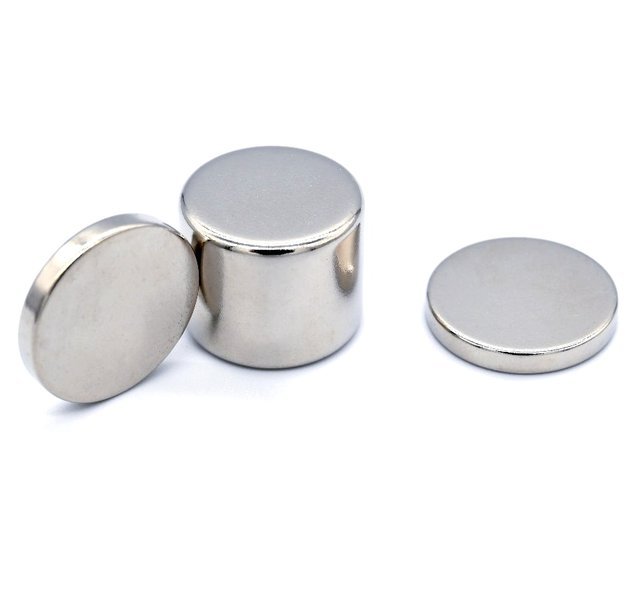
Disc Magnets & Cylinder Magnets
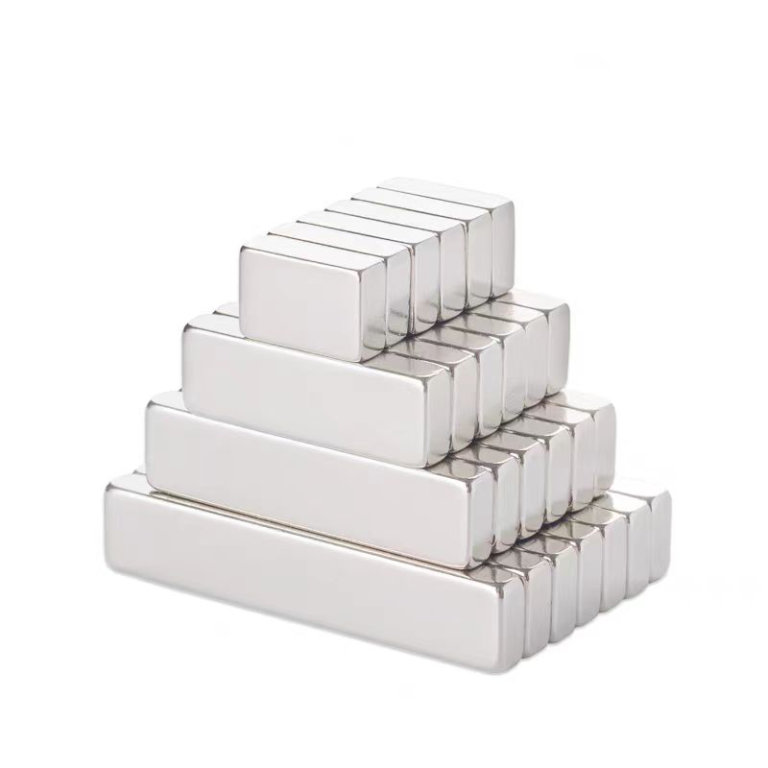
Block Magnets & Cube Magnets
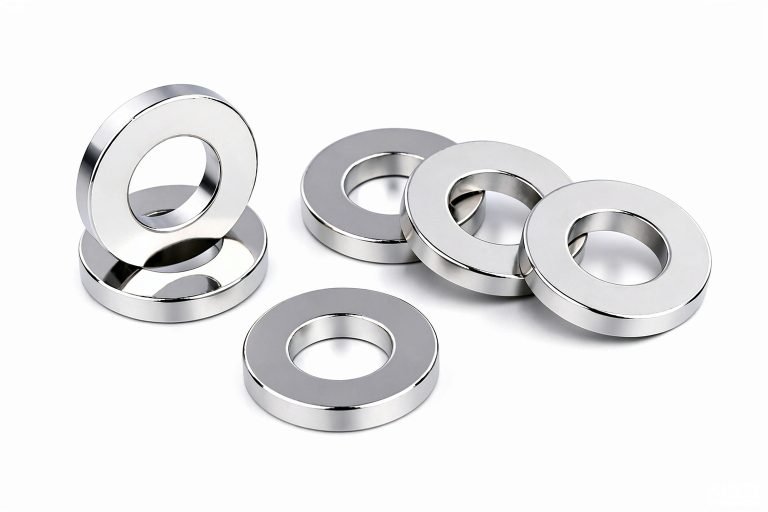
Ring Magnets & Countersunk Magnets
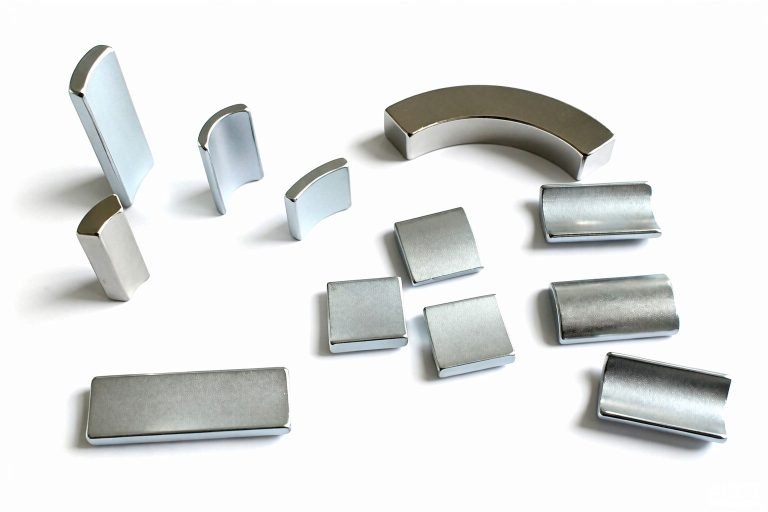
Arc Magnets & Segment Magnets
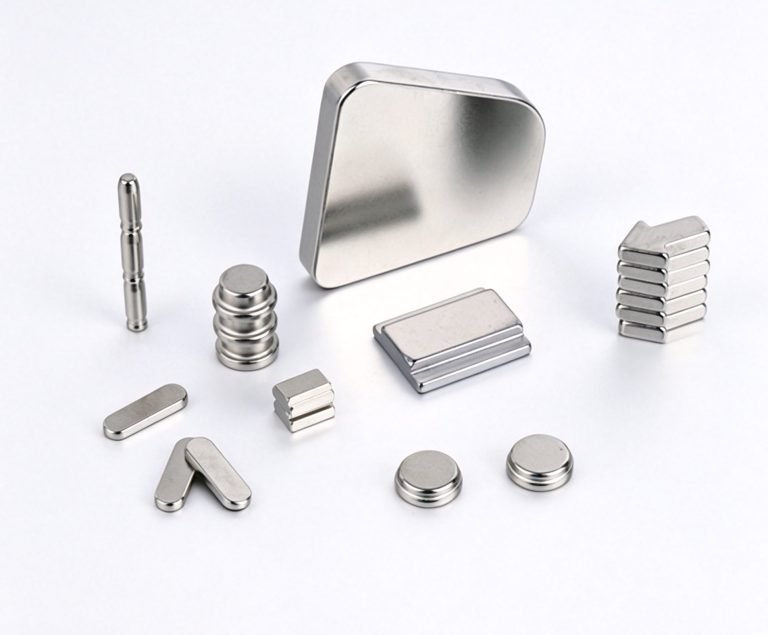
Adhesive Magnets & Customized Magnets
Surface Treatment of Neodymium Magnets
Neodymium iron boron is prone to corrosion, so magnets are almost always plated or coated. The right coating depends on the environment and the required salt-spray life.
Surface Treatment Options for Neodymium Magnets
| Coating | Thickness (μm) | Color | Salt Spray Test (h) | Characteristics |
|---|---|---|---|---|
| Ni-Cu-Ni (triple layer) | 10–25 | Bright silver | 36–72 | Industry standard, best all-round durability |
| Black nickel | 10–30 | Dark grey | 48 | Decorative, low reflectivity |
| Zinc (blue-white / color) | 5–10 | Blue-white / iridescent | 24–48 | Economical protection, good for dry indoor use |
| Ni-Cu-Ni + Au / Ag / Sn | 16–25 | Gold / silver / dull silver | 72 | Solderable or cosmetic top layer |
| Epoxy (electrostatic / electrophoretic) | 15–30 | Black / grey | 96–168 | Excellent humidity and chemical resistance |
| Parylene C | 5–20 | Clear | 200+ | Conformal vapor-deposited film, thin and pinhole-free |
| Phosphate | 1-2 | Dark grey | 2 | Temporary protection for assemblies glued afterwards |
Corrosion performance also depends on shape and dimensions — sharp edges and small holes reduce coating uniformity. Salt-spray data per ASTM B117.
Magnetization direction is set during pressing and cannot be changed afterwards. Choose the orientation that matches your circuit — axial for direct holding, diametrical for rotation sensing, multipole for encoder rings and rotors.Magnetization Directions of Neodymium Magnets
Axial Magnetization
Diametrical Magnetization
Axially Multipole
Radial Magnetization
Diametrical Multipole
Applications of Neodymium Magnets
From 3 g sensor magnets to 200 kg lifting assemblies, neodymium magnets power modern industry.
Electric Vehicles
Consumer Electronics
Industrial Automation
Wind Power Systems
Magnetic Separation Equipment
Robotics & Actuators
How to Choose the Right Neodymium Magnet
Selecting the correct magnet means balancing strength, temperature, environment and geometry:
- Pull force: decide the required holding force, then work back to grade and size with a safety factor of 2–3.
- Temperature: pick the lowest-cost grade that exceeds your maximum operating temperature, including heat build-up in the circuit.
- Environment: humid, salty or chemical exposure calls for Ni-Cu-Ni or epoxy coatings; food and medical applications favor Ni-Cu-Ni + Sn or Parylene.
- Geometry: define the shape, tolerance and magnetization direction early — they are fixed at the pressing stage.
- Volume: for annual quantities above 10,000 pieces, grain-boundary-diffused or custom-blended grades can cut cost-per-Newton significantly.
Not Sure Which Grade Fits?
Describe your application and working temperature. Our engineers reply with a grade recommendation and a factory-direct quote, usually within 24 hours.