When a design calls for a permanent magnet, the choice usually comes down to two materials: ferrite (ceramic) and neodymium (NdFeB). They sit far apart on price, strength, weight and temperature. This guide compares neodymium vs ferrite magnet on the numbers that decide a design, and shows when each one wins.
The Short Answer
Ferrite is cheap, rust-proof and works when hot. It is also weak for its size. Neodymium is the strongest magnet you can buy per gram, but it costs more and needs a coating. A simple rule covers most cases. If space or weight is tight, choose neodymium. If cost and temperature rule and you have room, choose ferrite.
Neodymium vs Ferrite Magnet: How the Two Materials Compare
| Property | Ferrite (ceramic) | Sintered neodymium (NdFeB) |
|---|---|---|
| Remanence Br (T) | 0.38–0.42 | 1.17–1.48 |
| Energy product (BH)max (kJ/m³) | 26–33 | 263–422 |
| Max working temperature | up to 250 ℃ | 80–230 ℃ by grade |
| Density (g/cm³) | about 4.9 | about 7.5 |
| Corrosion | Rust-proof, works bare | Corrodes in air, needs coating |
| Relative cost | lowest | higher |
| Typical use | speakers, low-cost clamps, hot areas | motors, sensors, compact high-force parts |
Working Point: What You Actually Get
The energy product tells you how much energy a material stores. It does not tell you how much flux you get in your own assembly. That number comes from the working point.
The working point is where your magnetic circuit crosses the demagnetization curve. A long magnet in a closed steel circuit works high on the curve. A thin magnet in open air works low. The slope of this crossing is set by the geometry, not by the material.
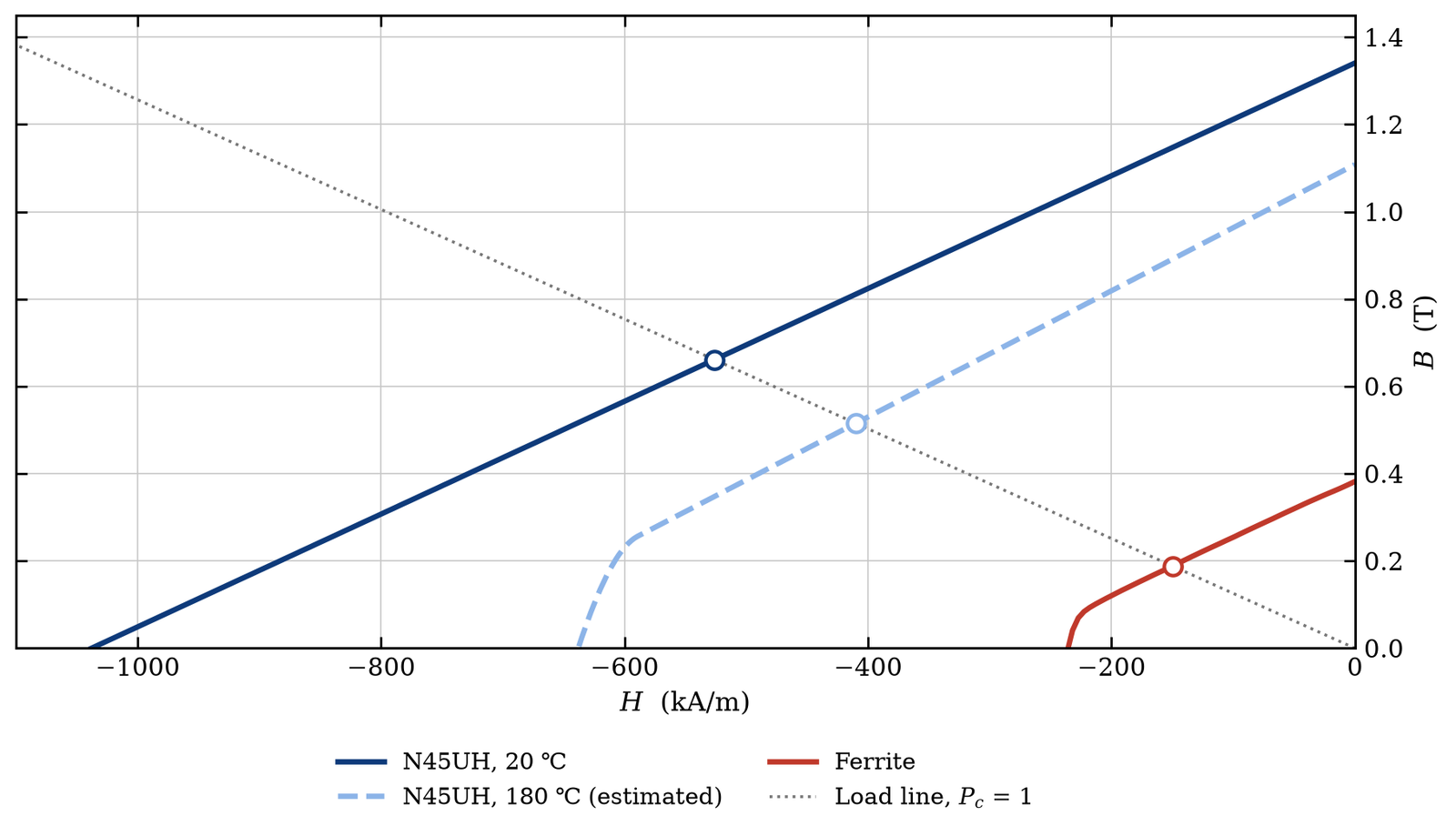
On this load line, the neodymium block works at 0.66 T. Ferrite sits at 0.19 T. That is 3.5 times the flux in the same space. The energy product says ten times. The working point says 3.5 times. Both are real. The working point is the one you build with.
Strength: Neodymium Wins on Size and Weight
Neodymium stores about ten times more energy per unit volume than ferrite. In practice, a small neodymium disc can out-pull a ferrite block several times its size. When a part has to fit a small gap or stay light, neodymium is the only practical option.
Cost: The Real Trade-Off Is Cost per Unit of Force
Ferrite is cheaper by weight. That does not always make the finished part cheaper. To match the field of a neodymium magnet, a ferrite part has to be much larger. So for small parts, neodymium often costs less overall. For large parts that only need a gentle force, ferrite is hard to beat.
A Worked Example: 18 kg of Pull
Here is a real spec. The part must hold 18 kg straight off a 10 mm steel plate at 20 ℃. It works at room temperature, so a standard grade is enough, and the example uses N35.
| N35 neodymium | Y30 ferrite | |
|---|---|---|
| Pull force | 18 kg, vertical | 18 kg, vertical |
| Steel plate | 10 mm | 10 mm |
| Magnet size | D18 × 3 mm | D40 × 7 mm |
| Magnet volume | 763 mm³ | 8796 mm³ |
| Magnet weight | ≈5.7 g | ≈43 g |
| Finished cost (relative) | ≈2× | 1× |
A N35 neodymium disc 18 mm across and 3 mm thick does the job. A Y30 ferrite disc needs 40 mm across and 7 mm thick for the same pull. The ferrite part holds 11.5 times the volume and 7.5 times the weight.
Same pull, 11.5 times the volume and 7.5 times the weight. On price the gap is far smaller. Neodymium costs much more per gram, but you buy far fewer grams. At this size the finished neodymium part costs about twice the ferrite part. That ratio moves with grade, quantity and tooling, so treat it as a guide, not a quote.
Temperature: The Sign of the Coefficient Flips the Story
Heat moves the two materials in opposite directions. Ferrite resists demagnetization better when it is hot. Neodymium resists worse.
| Temperature coefficient | Sintered NdFeB | Ferrite |
|---|---|---|
| Br coefficient (α) | -0.12%/℃ | -0.2%/℃ |
| Hcj coefficient (β) | -0.55%/℃ | +0.3%/℃ |
Look at the signs on the Hcj line. Ferrite carries a plus sign. Its resistance to demagnetization improves as it heats up. Neodymium carries a minus sign. Heat eats into its safety margin.
This shows up as a moving knee on the demagnetization curve. As temperature rises, the knee of the neodymium curve pulls inward. Keep the working point above the knee. If the working point falls below the knee, the magnet loses part of its field and never gets it back.
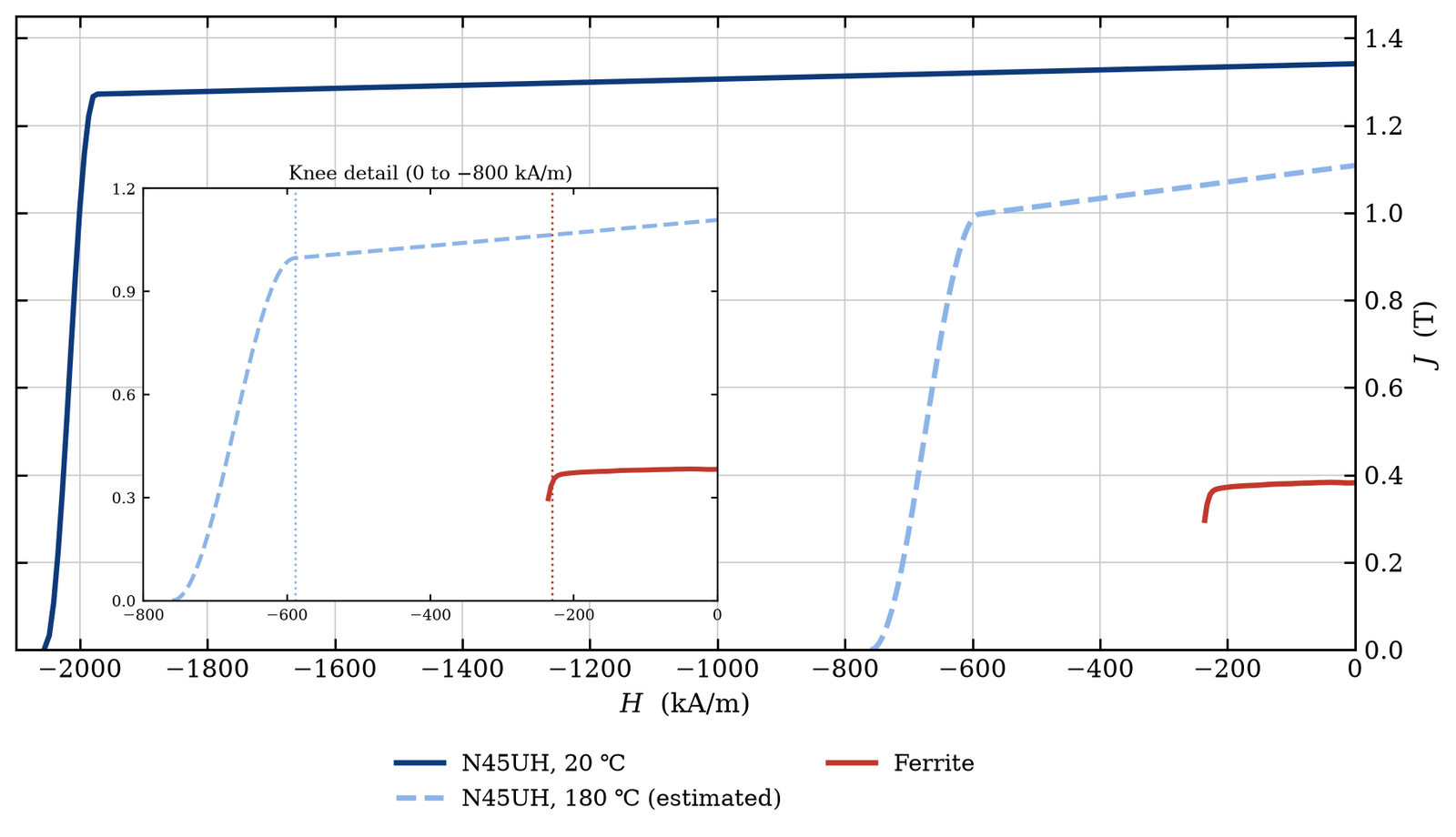
At 180 ℃ the knee of this N45UH grade sits near 590 kA/m. A working point at 410 kA/m still clears it, but the margin is thin. Ferrite keeps its knee near 230 kA/m, and that knee moves the safe way as it gets hotter. This is why ferrite owns the hot applications.
Corrosion and Coating
Ferrite does not rust, so it can be used bare. Sintered neodymium corrodes in air, so it is always coated with nickel-copper-nickel, epoxy or zinc. That coating adds thickness, and thickness changes the fit and the air gap. See our coating guide for how to choose the right plating.
When Ferrite Is the Better Choice
- Large parts where cost matters more than size.
- Hot environments, up to about 250 ℃.
- Parts used bare, outdoors or in moisture, with no coating.
- Applications that only need a gentle holding force.
When Neodymium Is the Better Choice
Reach for neodymium when the part is small, light, or has to deliver real force at a gap. That covers most motors, sensors and compact assemblies. We make sintered neodymium to drawing, so the shape can follow your design rather than the other way round. Start from our block magnets, disc magnets and ring magnets, or see the arc segment magnets used in rotors. If the shape is unusual, we machine it as a custom magnet.
If You Are Replacing Ferrite With Neodymium
You cannot usually swap one for the other at the same size. A neodymium part gives a much stronger field, so it is normally made smaller to match the force you already have. The field, the working point and the temperature behaviour all change. The same logic is covered in our guide to replacing a samarium cobalt magnet with neodymium. If you are still choosing the material, start with how to choose the right magnet, then fix the grade with how to choose a strong neodymium magnet.
Frequently Asked Questions
Is ferrite stronger than neodymium?
No. Neodymium is roughly three to four times stronger for the same volume. Ferrite only wins on cost and on high-temperature behaviour.
Why is neodymium more expensive than ferrite?
Neodymium is a rare-earth element, so it is mined and processed at a higher cost than iron oxide. Higher grades also add dysprosium for heat resistance, and that raises the price further.
Can neodymium replace a ferrite magnet directly?
Not at the same size. A neodymium magnet the same size would give a far stronger field, so you normally choose a smaller one. Check the working point and the gap before you commit.
Which is better for high temperature?
Ferrite, up to about 250 ℃. Neodymium needs a high grade such as SH, UH or AH to work above 120 ℃, and those grades cost more.
Ferrite or Neodymium? Send Us the Constraint
Send the size you have, the force you need and the temperature it sees. We will tell you whether ferrite or neodymium fits, and what the part costs at your quantity.
Ask About Your Part