We wrote this page to answer one question buyers ask us most often: how to choose a strong neodymium magnet. The word strong gets used loosely in our trade. Two magnets can both be called strong, yet one holds and the other lets go. The answer is never a single grade. It comes from three things you can check before you order. This page sets them out in order. You will know which grade to ask for and why.
The problem
Catalogues sell you on the word strong. But strong is not one number. It depends on your working temperature, your shape and your air gap, and only then on the grade. Skip any one and you buy the wrong magnet. A magnet that is the strongest on paper can still fail in your assembly if the temperature is wrong or the gap is too wide.
What we checked
Working temperature
Neodymium magnets lose strength as they heat up. A plain N grade works up to about 80℃. Above that, part of the loss is permanent. The fix is a high-temperature grade. These grades carry a letter after the number, and each letter works to a set temperature.
| Grade letter | Max working temperature | Typical HcJ |
|---|---|---|
| N | 80℃ | ≥955 kA/m |
| M | 100℃ | ≥1114 kA/m |
| H | 120℃ | ≥1353 kA/m |
| SH | 150℃ | ≥1592 kA/m |
| UH | 180℃ | ≥1990 kA/m |
| EH | 200℃ | ≥2387 kA/m |
| AH | 230℃ | ≥2785 kA/m |
The table gives reference points. The real limit also depends on the magnet shape. A thin magnet demagnetises sooner than a thick one, because its shape does less to resist the reverse field. Read the temperature inside the assembly, not the air around it. A magnet inside a running motor is hotter than the room it sits in.
Shape and air gap
Shape decides how the field reaches your load. A disc, a block and a ring of the same volume push their field out in different ways. The air gap matters even more. Pull force falls off very fast as the gap grows. Double the gap and the pull drops to about a quarter, not a half. A smaller gap often helps more than a higher grade.
Grade
The number in N35, N42, N45 and N50 is the maximum energy product. A higher number packs more magnetic energy into the same volume, so it gives more pull in the same space. The trade-off is cost and brittleness. Higher grades cost more and crack more easily. We stock grades from N30 to N38AH, with no fixed minimum order. The table and the curve below show what changes as the number rises.
The comparison
| Grade | Br (T) | (BH)max (kJ/m³) | Max temp | Relative cost | Typical use |
|---|---|---|---|---|---|
| N35 | 1.17–1.21 | 263–287 | 80℃ | Lowest | Sensors, simple holding |
| N42 | 1.29–1.33 | 318–342 | 80℃ | Low | Motors, loudspeakers |
| N45 | 1.32–1.38 | 342–366 | 80℃ | Medium | Higher-power motors |
| N50 | 1.40–1.44 | 382–406 | 80℃ | High | Compact, space-limited parts |
| N52 | 1.43–1.48 | 398–422 | 80℃ | Highest | Compact parts needing the highest flux |
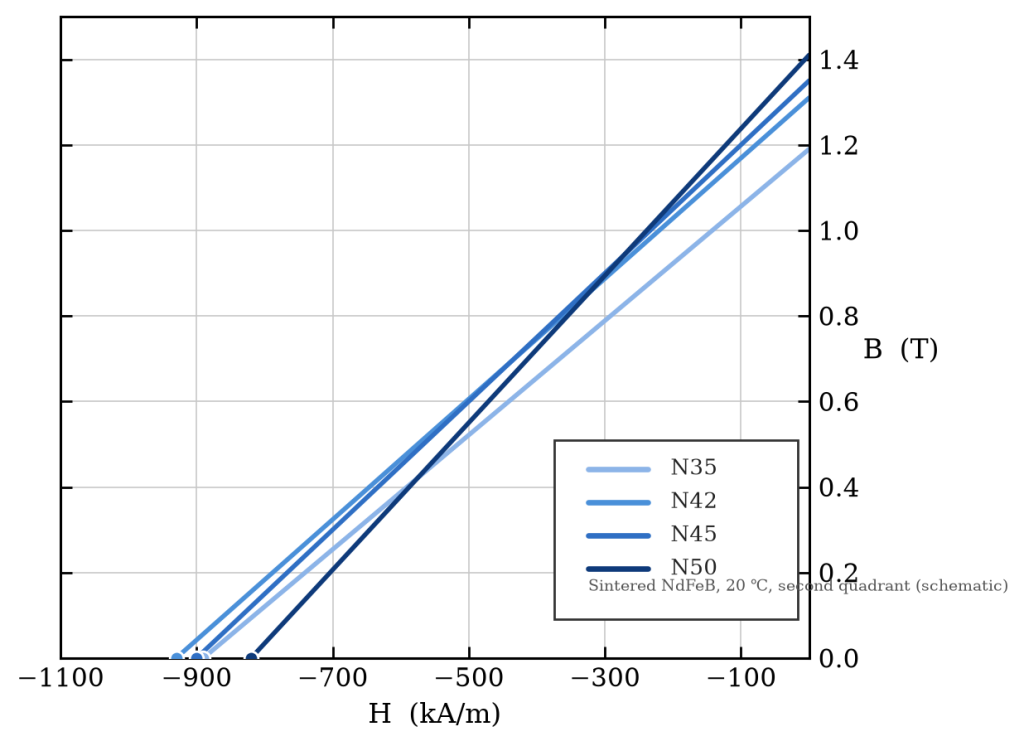
How to Choose a Strong Neodymium Magnet in Three Steps
Work through three steps in this order.
- Fix your maximum working temperature. If it stays under 80℃, a plain N grade is enough. If it runs hotter, move to M, H, SH, UH or higher. Do not skip this step. An N52 magnet left at 100℃ loses strength and never gets it back.
- Fix the shape and the gap. These set the size and the pull force you need. Tell us the gap in your enquiry. A magnet that holds at 1 mm may fail at 3 mm.
- Pick the grade and the coating. Choose the lowest number that meets your pull force with a small margin. Do not pay for N50 when N42 does the job. Add parylene and dacromet coating only if the magnet sits in a wet or corrosive place.
What would change the answer
Four conditions move the choice. High temperature pushes you to a letter grade and lowers the number you can use. A wide air gap pushes you to a bigger magnet or a higher grade. A wet or corrosive place adds a coating, and the coating eats into the gap. A large order often lets you step down a grade and still meet your cost target.
Frequently Asked Questions
How do I measure pull force at the gap I will actually use?
With a motorised pull tester rather than a hand scale. The usual setup is a 10 mm steel plate, a pull speed of 50 mm/min, and the peak of each pull. Test several parts and average them, because pull force scatters more than the dimensions do. Set the gap in the fixture at the value your design uses, which is normally 0.5 to 1 mm. A wider gap suits a large magnet or a special case.
Does the direction of magnetisation matter?
It can matter more than the grade. The same disc gives a very different field depending on whether it is magnetised through its thickness or across its diameter. Tell us which way the field has to point before the parts are ordered, because it is set in the magnetiser and not afterwards.
What is your minimum order quantity?
There is no fixed minimum. We quote from one piece, and the unit price steps down with quantity. A prototype order is normal here.
Tell Us the Pull Force You Need
Send the shape, the air gap and the load it has to hold. We will come back with a grade, a size and a pull force figure, so you can compare options before you commit.
Get a Recommendation