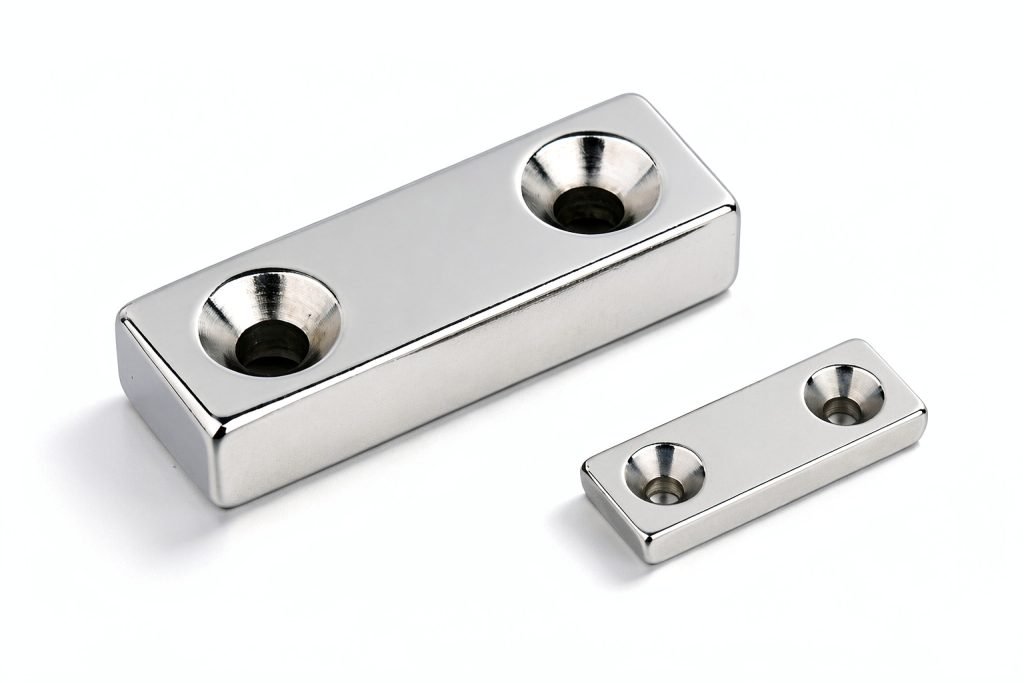
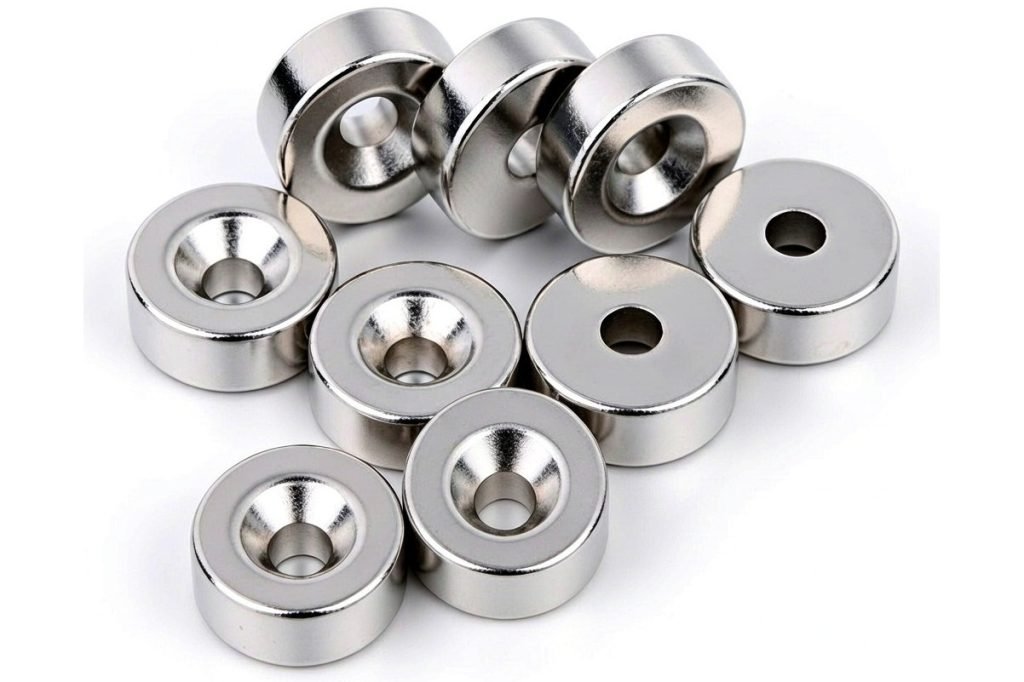
Countersunk neodymium magnets and plain ring magnets all have a hole through the centre. They come as plain rings, countersunk discs or countersunk blocks.
A ring does two jobs at once. The magnet grips the steel surface, and the screw through the hole fixes the part to your product. That is why rings and countersunk magnets are the standard choice for closures, signs and anything attached and released many times.
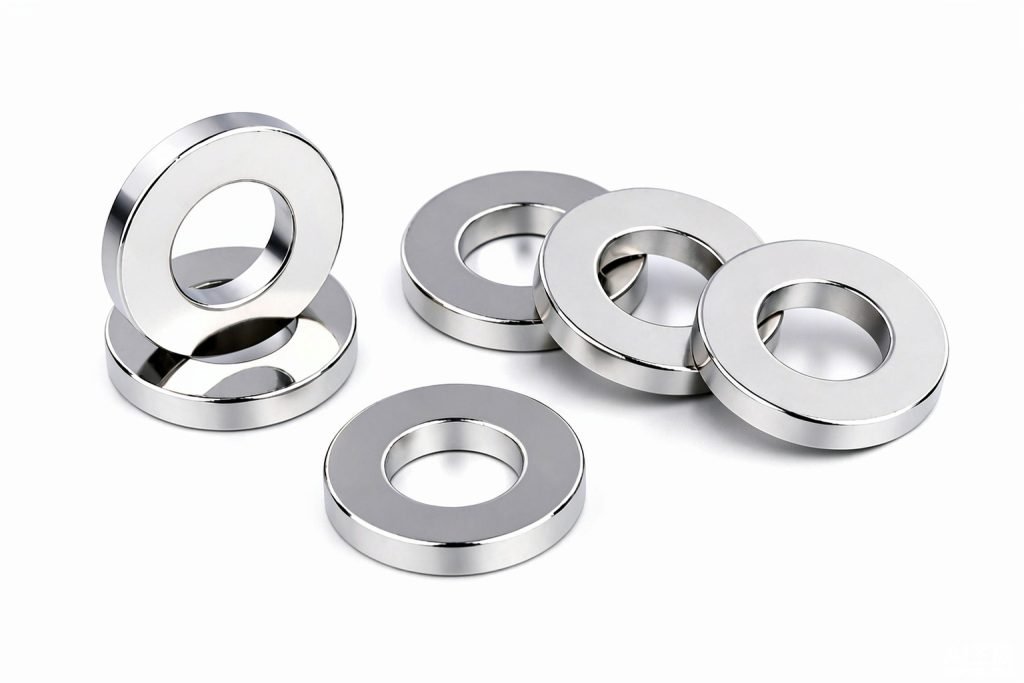
What Ring and Countersunk Neodymium Magnets Are Used For
A countersunk magnet is often used as a door closure. Screw-mounted magnets hold cabinet doors, gates, display panels, tool boxes and kitchen units shut with no visible latch. They release with a quiet pull.
- Shop-fitting: signage, shelves, lighting fixtures and exhibition displays on steel frames
- Home: picture frames, noticeboards, removable covers
- Heavier panels: countersunk blocks with two holes
Two screws stop the magnet rotating downward under load. That is why a double-hole block holds more than a single-hole one of the same size.
The same idea works in reverse. Where the product itself cannot be drilled, mount the magnet to the fixed steel frame and put a plain steel striker plate on the loose part. Nothing is threaded and nothing is visible. The panel still comes off with a pull.
How Countersunk Neodymium Magnets Work
A ring magnet does two jobs at once. The screw through the hole carries the structural load. The magnetized face grips the steel surface.
Grades from N30 to N38AH are available. For closures and light signage, N35 to N42 is usually enough. N45 and above are used for heavier doors. Magnetization is normally axial, through the thickness.
One thing to remember: the hole removes working area, and the flux is weakest around the bore. A ring of a given outside diameter therefore pulls less than a solid disc of the same size. The larger the hole, the more force is given up. A ring is chosen when the screw fixing matters more than the last few newtons of pull. Size the outside diameter up until the pull force is back where the design needs it.
Choosing the Hole and the Screw
Start from the screw, then size the magnet around it. A countersunk screw needs a matching 90° seat. The head dimensions are fixed by the standard, so they set the minimum size of the countersink and of the magnet.
| Screw | Countersink diameter (head Ø, max) |
Countersink angle | Clearance hole in the panel |
|---|---|---|---|
| M3 | 6.72 mm | 90° | 3.4 mm |
| M4 | 8.96 mm | 90° | 4.5 mm |
| M5 | 11.2 mm | 90° | 5.5 mm |
| M6 | 13.44 mm | 90° | 6.6 mm |
| M8 | 17.92 mm | 90° | 9.0 mm |
| M10 | 22.4 mm | 90° | 11.0 mm |
| M12 | 26.88 mm | 90° | 13.5 mm |
Head diameters are the ISO 10642 / DIN 7991 maxima. Clearance holes are the ISO 273 medium fit. Three rules follow.
- The magnet must leave solid material around the seat after the countersink is cut. The outside diameter always runs beyond the countersink diameter.
- Pick a screw length that matches your panel thickness. Leave about 0.2–0.3 mm of clearance in the bore so the magnet drops in without a fight.
- The head must sit fully flush in the seat. No gap, no proud edge.
Anything that lifts the magnet off the steel surface is an air gap, and an air gap costs pull force.
One trap worth naming. Metric countersunk screws are 90°. Inch-series socket flat head screws (ANSI B18.3) are 82°. A seat cut at the wrong angle will not let the head bed down, and tightening it then loads the brittle magnet on one edge. Tell us which standard your screw follows, or send us the screw, and the seat will be cut to match.
How Countersunk Neodymium Magnets Are Drilled
The raw cylinder magnet is drilled to your drawing first, then cut into pieces. Diamond tooling is used throughout. The countersink is cut in the same machining step, so the seat and the bore stay concentric.
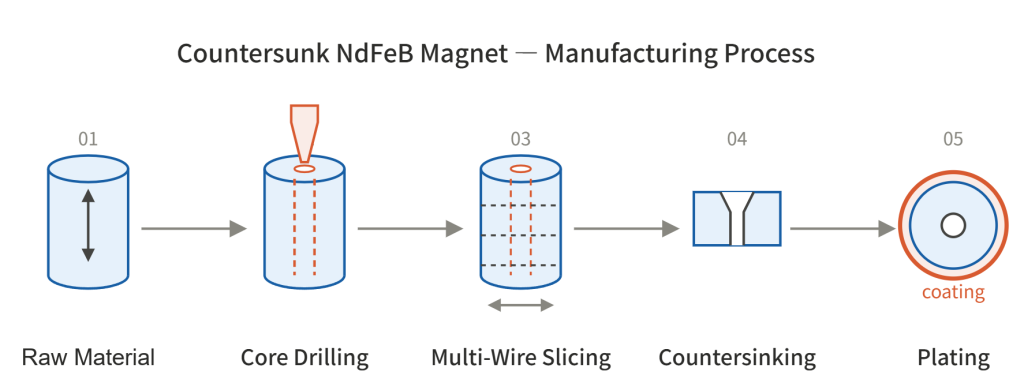
Plating always comes after drilling, never before. Drilling a plated part would leave the inside of the hole bare, and that is the first place to corrode. Coating therefore reaches inside the bore as well as over the outside. This matters because the hole is where moisture collects.
Nickel-copper-nickel is the standard finish. Zinc, epoxy, gold and black nickel cover high humidity, salt spray and solvent exposure. Plating also builds up unevenly on a bore. If the screw fit is critical, say so, and the bore is ground to leave room for the coating. For the options side by side, see our guide to neodymium magnet coating.
Tolerance of the Hole and the Countersink
Standard tolerances run from ±0.1 mm down to ±0.05 mm.
Two dimensions decide whether the assembly works: the countersink angle and its depth. A 90° screw head sitting in a seat cut a degree or two off will not bed down. The head then bears on one edge, and tightening it loads the brittle magnet unevenly. That is a common cause of cracked countersunk magnets, and it is a tolerance problem rather than a material one.
Hole position matters as much where there is more than one. On a double-hole block, if the hole spacing on the magnet does not match the panel, the screws pull the magnet sideways and the working face no longer sits flat. Agree the hole pattern on the drawing. We will check the bore, the seat depth and the hole spacing against it before production.
Edge Treatment That Survives a Screw
Edges are chamfered 0.2 to 0.5 mm on both the outer rim and the hole rim. That removes the corners that chip easily.
The chamfer on the hole does a second job. It protects the coating where the screw shank passes through, which is the point most likely to be scraped during assembly.
On a countersunk magnet the cone-shaped seat already acts as a large chamfer, so it is relieved. What is worth adding is a small radius on the outer edge of the countersink, so the cone does not cut into the housing it presses against.
Where a ring is pressed into a counterbore rather than screwed down, ask for a radius instead of a chamfer on the outer rim. A rounded rim slides into a tight bore. A chamfered one shaves its own plating off on the way in.
Frequently Asked Questions
Do countersunk magnets hold less than a plain ring magnet?
A little less. The countersink removes material from the working face, so a countersunk magnet carries slightly lower pull than a plain ring magnet of the same size. What you gain is a screw seat, and on a closure that matters more than the last few percent of pull.
Why is a ring magnet weaker than a solid disc of the same size?
Because the hole is not part of the magnetic circuit. It removes face area, and the flux is weakest around the bore. A ring always pulls less than a solid disc of the same outside diameter. Size the outside diameter up until the pull force is where you need it. A ring is bought for the fixing, not for its force.
Can the hole be tapped instead of countersunk?
A thread can be cut into a larger sintered magnet, but it is rarely the best answer. Sintered neodymium is brittle and has low shear strength, so a thread in it strips easily. The usual approach is a clearance bore with a countersunk seat, with the screw threading into the panel or a nut plate behind it. Tell us what you are trying to achieve and we will suggest a bore and seat arrangement that holds.
Do countersunk magnets have to be magnetized axially?
Almost always, yes. The working face has to be one flat pole. Multipole and diametrical patterns are used in sensing, where the magnet is not holding anything. See the disc and cylinder magnets page for those magnetization options.
What if the housing is not steel?
Then the magnet needs a steel partner. On aluminium, plastic or glass, screw the magnet to the fixed part and mount a plain steel striker plate on the moving part. The magnetic circuit then closes through steel on both sides. If neither part can be drilled, an adhesive-backed magnet removes the need for a screw altogether.
Send us your drawing and our engineers will confirm the right ring or countersunk magnet before production. You can also browse the full neodymium magnet range by shape.