Neodymium disc magnets are the most common shape we make. It has one flat pole face and is magnetized through the thickness. Disc magnets cover the widest range of jobs of any shape we make, from a fridge magnet to a sensor magnet inside a steering column. A cylinder is the same shape with more height.
Discs and cylinders are pressed close to finished size and ground on one axis. That makes them the cheapest neodymium shape per unit of pull force, and the quickest to produce.
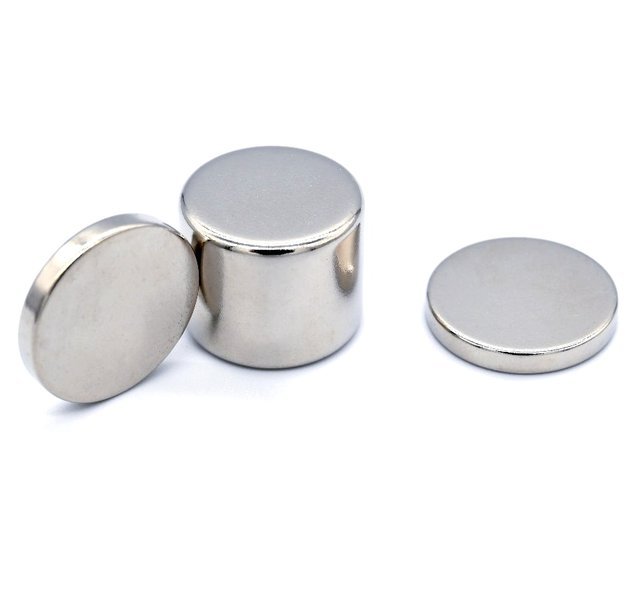
What Neodymium Disc Magnets Are Used For
Disc and cylinder magnets are used where compact force is needed in a round space. A disc sits flat on a steel sheet. A cylinder drops into a drilled hole or a sleeve and holds along its axis.
- Holding and clamping: jigs, fixtures, door catches, tool and knife holders
- Signage and display: fridge magnets, nameplates, retail fixtures, exhibition panels
- Sensors: hall-effect and reed switches, angle and speed sensors
- Audio: loudspeakers and earbuds
- Motors: small brushless motors, stepper motors, vibration motors
- Packaging and closures: gift boxes, folders, bags, dispensers
- Medical and wearable: device covers, orthopaedic aids
- DIY and education: whiteboard pins, models, toys
The shape is symmetrical. A disc can be dropped into a counterbore and rotated without changing its pull. That makes it the default choice for anything located by a hole rather than by a flat face.
How Do Neodymium Disc Magnets Work?
A disc magnet is magnetized along its axis. One flat face is north, the other is south. Flux leaves one face, crosses the gap and returns to the other. The pull is strongest directly off the face and falls away steeply with distance. A disc is a close-range magnet, not a long-range one.
Two numbers decide what a disc will do. The first is the grade, which sets the flux the material can produce. Grades run from N30 to N38AH. The second is the ratio of diameter to thickness.
With the magnet flat against clean steel, face area does most of the work. Double the diameter and you roughly quadruple the pull. Double the thickness and you gain far less, because the magnet is already working near its remanence. Stacking more height gives diminishing returns. Every diameter has a thickness beyond which extra material buys almost nothing.
Open a gap and the balance moves towards thickness. A thicker disc has a higher permeance coefficient, so it drives flux across the distance better and keeps a larger share of its pull. A very thin, wide disc has plenty of face area, but loses its force quickly once it leaves the steel.
Most designs do not have a large gap. Paint, a painted panel or a layer of tape is a small gap, and across a small gap the face area still does most of the work. For those gaps a wider disc is the better change. Thickness earns its place when the separation is genuinely large, or when the magnet has to work at a distance rather than in contact.
For a cylinder the same rules apply until the length exceeds the diameter. Past that point the field reaches further along the axis and the part behaves more like a rod. Cylinders are used when the magnet has to be sensed at a distance, or when the housing is a drilled hole.
Axial and Diametrical Magnetization
Most discs are axially magnetized, through the thickness.
A disc can also be magnetized diametrically. North is then on one side of the rim and south is on the other, and the field runs across the diameter. A diametrical magnet has almost no pull against a flat steel plate, because the poles are not on that face. It creates a two-pole pattern that a sensor reads as the magnet turns.
Diametrical discs and cylinders are used in robot gimbals, automotive steering-angle sensors and valve position detection. The magnet turns with the shaft and the sensor measures the angle.
Two points to note. Diametrical parts are usually ordered in higher grades and tighter tolerances, because the air gap in a sensor is small and a position error shows up as a measurement error. The magnetizing fixture is also dedicated, so the pole orientation must be on the drawing before production starts.
Axial Magnetization
Diametrical Magnetization
Why Neodymium Disc Magnets Lead on Price and Lead Time
Two things make the disc the cheapest neodymium shape to buy.
Pressing. The die forms a cylinder close to finished size. A disc therefore needs less grinding than a block, and far less than a ring or an arc.
Symmetry. A round part is ground on one rotating axis. That is fast, and easy to hold to tolerance. A block has four faces to bring square. A disc has one diameter.
Discs are therefore also the fastest shape to produce. Where two design options give similar magnetic performance, the disc will usually be cheaper and delivered sooner.
N35 is common in volume disc production. Where size and weight are not critical it costs less and machines well. Consumer-grade magnets are typically N40 to N42.
How Disc and Cylinder Magnets Are Produced
The powder is pressed in a die that already has the disc or cylinder shape. Pressing happens in a magnetic field, which aligns the crystal orientation. The pressing direction becomes the easy axis, and it cannot be changed later. A diametrical pattern comes from the magnetizing fixture, not from pressing.
After sintering, the outside diameter is ground true and the two faces are ground flat and parallel. Longer cylinders are sliced from a sintered rod on a multi-wire saw, then ground.
A disc or cylinder holds a rounder diameter and better parallelism than a block of the same volume, because the wall around the axis is uniform. Grinding cost per part is lower as a result.
The parts are then cleaned, plated, magnetized and inspected. Our How We Work page shows the full sequence step by step.
Grade, Coating and Temperature
Choose the grade from the temperature the magnet will reach, not the temperature of the room. The suffix after the grade number gives the working temperature:
- No suffix: 80 °C
- M: 100 °C
- H: 120 °C
- SH: 150 °C
- UH: 180 °C
Diametrical sensor magnets are usually specified in H grade or higher. A sensor has no margin for a shift in output caused by heat.
Every sintered disc is plated. Raw neodymium corrodes and crumbles in air, and the plating also turns the black sintered blank into a clean, hard, bright part. Nickel-copper-nickel is the standard finish. Zinc, epoxy, gold, Parylene and Dacromet cover humid, salty, chemical and skin-contact use. The comparison is in our guide to neodymium magnet coating.
Diameter, Thickness and Parallelism
A ground disc holds its diameter, thickness and parallelism closely. The normal working range is ±0.05 mm on critical dimensions and ±0.1 mm on general dimensions. Perpendicularity between the diameter and the face is also controlled. A disc that is not square wobbles in a counterbore.
Both rims are chamfered 0.2 to 0.5 mm. The chamfer lets a disc be pressed into a bore without shaving the plating off, and it removes the sharp corner where a thin disc would chip.
Thin discs are the most fragile parts in the neodymium range. If the design uses a large diameter with little thickness, tell us. We will confirm a grade and edge treatment that survives assembly.
Frequently Asked Questions
Are neodymium disc magnets the same as cylinder magnets?
The face is the same, only the height changes. A neodymium disc magnet is wider than it is tall. A cylinder magnet carries the same diameter with more height, so cylinder magnets hold through a thicker gap. Both are magnetized through the thickness unless you ask for a diametrical orientation. Disc magnets are the shape we quote most often, and cylinder magnets run on the same tooling.
What is the difference between a disc magnet and a cylinder magnet?
Only the height. A cylinder is a disc grown along the axis. A disc is used where the magnet must sit flat and thin. A cylinder is used where it has to fill a drilled hole, press into a sleeve, or be sensed from further away.
Should I use a wider disc or a thicker one?
It depends on the gap. With no gap, face area does the work and a wider disc wins. As the gap grows, thickness becomes relatively more valuable. The chart above shows where the two cross over. Across paint, a panel or a layer of tape the face area still dominates, so a wider disc is usually the better change. If space is tight, tell us the gap and we will size the magnet against the real geometry.
What is a diametrically magnetized disc used for?
Angle and position sensing. The two poles sit on opposite sides of the rim, so a hall-effect or magnetoresistive sensor beside the turning magnet reads a changing field. Typical uses are robot gimbals, steering-angle sensors and valve position detection. A diametrical magnet has almost no holding force against a flat plate.
Can a disc magnet be fixed with adhesive instead of a screw?
Yes. For discs it is often the neatest solution, because there is no hole to drill and no head to hide. We supply discs laminated with a pressure-sensitive tape, ready to peel and press. See adhesive magnets for the tape options and the surface preparation they need.
Send us your drawing and our engineers will confirm the diameter, grade and magnetization direction before production. You can also browse the full neodymium magnet range by shape.