Neodymium block magnets are the most widely used shape. It has a flat, wide working face and straight edges. That combination gives strong pull from a small footprint, and it makes the magnet easy to stack, recess or machine.
Blocks are the shape most often turned into custom assemblies. They are used for holding, clamping and lifting.
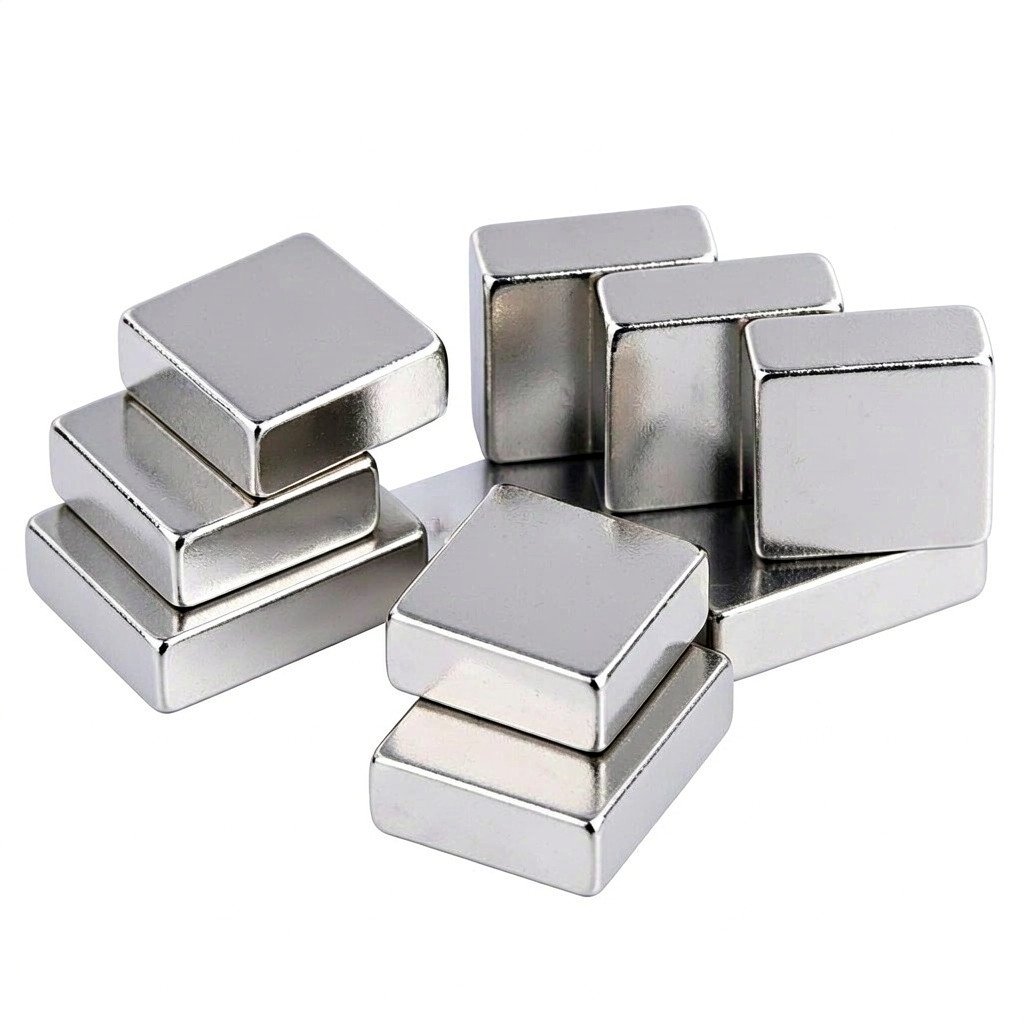
What Neodymium Block Magnets Are Used For
Block and cube magnets work on flat, compact surfaces. The holding force is applied straight through the face.
- Clamping fixtures and light workpieces on machine beds and welding tables
- Tool holders, brush mounts and filter mounts
- Signage and shelf brackets
- Product separation on conveyors
- Workshop use: holding screws, tools and sheet metal
- Craft and education: closures, whiteboard accessories, models
Straight edges and parallel faces do more than hold. Several blocks butt together into a wide gripping array without gaps. Magnetic chucks and large plate magnets are built this way. Cube magnets do the same job at a smaller scale.
The flat faces also make the part easy to install. A block can be recessed into a pocket, bonded to a plate, or drilled and counterbored so a screw carries the load.
How Do Neodymium Block Magnets Work?
Three things set the holding force of a block magnet: the grade, the magnetization direction, and the geometry of the part.
Grade sets the flux the material can produce. Grades run from N30 to N38AH. Higher numbers give more force per unit of volume. They are also more brittle and more expensive, which matters on a thin part. For most holding and clamping jobs N35 to N42 is enough. The money is better spent on a thicker magnet than on a higher grade.
Magnetization direction decides where the flux goes. Blocks are normally magnetized through the thickness, straight through the two largest faces. That puts the full face area to work and gives the best force for the lowest cost. Magnetizing through the length spreads the field further, which suits sensors and reed switches where the magnet has to be sensed from a distance. Some blocks carry multiple poles across one face for encoder and position-sensing tracks.
| Application | Common structure | Magnet type |
|---|---|---|
| Rotary angle encoder (motor shaft) | Multi-pole ring magnet (mostly axial) | Bonded NdFeB one-piece ring / sintered segment-assembly ring |
| Long-stroke linear position sensing | Sintered NdFeB block NS array | Sintered NdFeB block |
| Short-stroke high-accuracy linear magnetic scale | One-piece multi-pole bonded strip magnet | Bonded NdFeB |
| Simple speed detection (single pulse) | Single block magnet (one pole pair) | Sintered NdFeB |
Geometry matters as much as the grade. Force does not scale with volume alone. Two magnets of the same mass behave differently once there is a gap. Across a gap the thicker of the two holds up better, because its higher permeance coefficient drives flux across the distance more effectively.
Most assemblies have only a small gap, though. Paint, a panel or a layer of tape is a small gap, and there the face area still does most of the work. Adding width is usually the cheaper change. If the available space is round rather than rectangular, a disc or cylinder magnet fits the bore better and wastes less of the face.
Sintered neodymium is permanent. The magnet does not run down over time. Three things reduce force in service: heat above the grade’s working temperature, a strong opposing field, and an air gap. The gap is the common one. Paint, powder coat, a gasket and adhesive are all gaps, and a gap costs force quickly.
Axial Magnetization
Axially Multipole Rectangular Magnet
Choosing the Grade and Coating
Grade and coating are decided together. Both are driven by the environment the magnet sits in.
For holding and clamping at room temperature, N35 to N42 in nickel-copper-nickel is the default and the cheapest route. If the part sits near something warm, choose the grade from the working temperature of the magnet, not the ambient air. The steel around it is usually hotter than the room. The suffix after the grade number gives the working temperature.
| Grade suffix | Max working temperature | Typical use |
|---|---|---|
| N30 – N55 (no suffix) | 80 °C | Indoor holding and clamping |
| M | 100 °C | Warm housings, normal motor frames |
| H | 120 °C | Motors, pumps, enclosed electronics |
| SH | 150 °C | Hot motors, positions near windings |
| UH | 180 °C | High-temperature and automotive-grade heat |
A higher suffix has slightly lower flux for the same grade number, so there is no benefit in over-specifying it. Every sintered neodymium part is plated, because the raw material corrodes in air. Nickel-copper-nickel is the standard indoor finish. Zinc, epoxy, gold and Parylene cover humid, salty, chemical and skin-contact use. For the full comparison, see our guide to neodymium magnet coating.
How Neodymium Block Magnets Are Machined
Blocks are the easiest neodymium shape to machine. That is part of why they are inexpensive.
The process starts with the alloy. Neodymium, iron and boron are melted, milled to a fine powder, pressed in a magnetic field and sintered at high temperature. Pressing aligns the crystal orientation. The pressing direction sets the easy axis of magnetization, so it is fixed at this stage and cannot be changed later. The drawing has to state the magnetization direction before production starts.
After sintering, the block is a rectangular blank, usually a little oversize. A diamond wire saw slices it to thickness. The faces are then ground flat and parallel. Flatness and parallelism are what the customer feels as a stable, rattle-free fit, so they are checked against the drawing. Steps, slots and holes are cut before coating. Machining after plating would strip the plating.
The parts are then cleaned, coated, magnetized and inspected. Blocks are dense and attract each other hard, so they travel in separated layers with steel plates above and below. Standard sizes ship in boxes. Orders that have to survive a long sea voyage or a humid warehouse are vacuum-packed as well. Our How We Work page shows the sequence stage by stage.
Tolerance and Edge Treatment
Block magnets are ground, so tolerances can be held tighter than on a shaped part. As standard, thickness and other critical dimensions are held to ±0.05 mm, and length and width to ±0.1 mm. End faces are square, so blocks butt together cleanly into an array.
Two tolerances are worth naming on the drawing, because they change the assembly more than they look like they should.
- Flatness of the working face. Any bow shows up as an air gap and costs holding force.
- Squareness. This decides whether a row of blocks sits flush against a shoulder or leaves a visible step.
Edges are chamfered 0.2 to 0.5 mm on the outside rim. Sintered neodymium chips at a sharp corner, and a block that has been handled, plated and packed will find that corner. On a drilled block the hole rim is deburred as well. That also helps the plating cover the inside of the hole, which is where plated parts normally start to corrode. If the assembly presses the magnet into a tight pocket, ask for a small radius rather than a sharp corner.
Designing a Neodymium Block Magnet into a Fixture
Most block magnet problems in the field come from three places: too much gap, the wrong magnetization direction, and a load pulling in a direction the magnet was not chosen for.
Start with the gap. A datasheet figure is measured with the magnet flat against a polished, thick steel plate. Paint, gaskets and adhesive all add distance, and force falls off steeply as that distance grows. If the magnet sits behind a 1 mm painted panel, size it against the gap, not against the datasheet number. Sandwiching the magnet between two steel plates closes the magnetic circuit and can raise the effective force noticeably for very little cost.
Check the load direction. Magnets resist shear far better than they resist being pulled straight off. A magnet sliding along a steel surface will hold much more than the same magnet supporting a hanging weight. Where the load is a direct pull, add a mechanical stop or a screw. The magnet should never carry the whole thing on its own.
Decide how the magnet is fixed. A block can be bonded with adhesive, retained by a screw through a counterbored hole, pressed into a pocket, or held in a steel housing that also acts as a keeper. A screw carries the structural load and lets the magnet do only the magnetic work. That is the most reliable arrangement for anything opened and closed repeatedly. For that job, a ring or countersunk magnet is built for it. The hole is already in the right place.
Two smaller points. Keep the magnet away from heat above its grade rating. And remember that these parts are brittle. A block dropped onto a concrete floor during installation cracks, and the crack is not always visible. Handle them the way you would handle ceramic.
Frequently Asked Questions
Do neodymium block magnets come in standard sizes?
We hold a few stock sizes, but most neodymium block magnets are cut to your drawing. Send the length, width, thickness and grade, and the block magnets are ground to ±0.02 mm on the working face.
What is the difference between a block magnet and a cube magnet?
Only the proportions. A cube magnet is a block magnet with roughly equal length, width and height. Cubes suit small, light loads in tight spaces. Longer blocks are used when the magnet has to bridge a distance or fit a slot in a housing.
Can neodymium block magnets be drilled?
Yes, with diamond tooling. The hole is drilled before coating and before magnetization. The plating then covers the inside of the hole, and no chips are left inside the part. Tell us the hole diameter, depth and position, and whether it has to be countersunk for a screw head.
Do neodymium block magnets lose their strength over time?
No. Sintered NdFeB is a permanent magnet material and holds its magnetism for decades in normal use. Force is lost if the magnet is heated above its grade’s working temperature, or if it is placed in a strong opposing field.
How is the holding force of a block magnet calculated?
Catalogue figures are measured on a polished steel plate with no gap. Treat them as a maximum. Work out the gap in your assembly, the direction of the load and the steel thickness behind the magnet, then take a margin. Send us the drawing and we will confirm a size and grade against the real geometry.
If you are not sure which grade, size or edge treatment your project needs, send us your drawing or a short description of the application. Our engineers will come back with a proposal within 24 hours. You can also browse the full neodymium magnet range by shape.